

By Walt Hickey
Welcome to the Numlock Sunday edition.
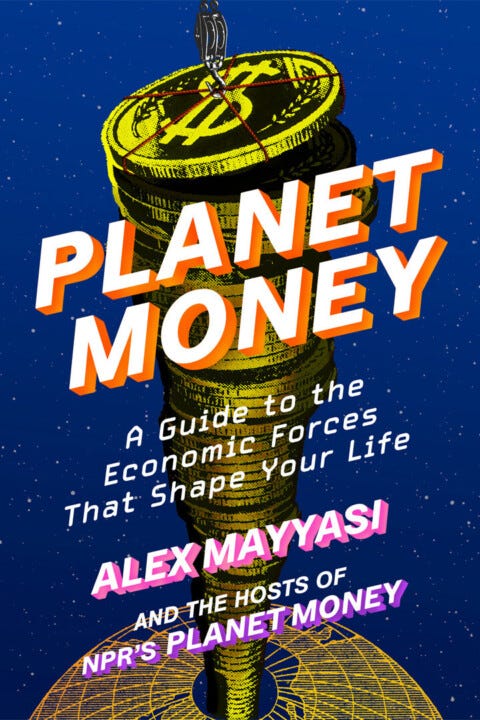
This week, I spoke to Alex Mayyasi from NPR’s Planet Money, the beloved podcast that invented an entire version of audio storytelling, who is out with a brand new book from the show called Planet Money: A Guide to the Economic Forces That Shape Your Life, a delightful anthology all about the ways money and the economy affect nearly everything in our daily lives
The book is very fun, and we talked about the Pickle Problem, the what we can learn about automation based on the example of bank tellers, and why insurance is the key to so much of our world.
The book is available wherever books are sold. Alex is a regular contributor to the Planet Money podcast, writes his own Substack, and will be out with a his next project, the Gastronomics podcast available on Spotify, soon. You can find Alex on his website at alexmayyasi.com.
This interview has been condensed and edited.
Alex, thank you so much for coming on.
Yeah, thanks so much for having me.
You are the author of Planet Money: A Guide to the Economic Forces That Shape Your Life. This is based on the incredibly popular, highly beloved, I’m a big fan, podcast. I’ll just throw it to you. Where did the book come from? And why Planet Money the book?
Yeah, I mean, there are a few different reasons. I think, from a personal perspective, I just wanted there to be a Planet Money book. And I thought it could be great. And my origin story is that I’ve been working with Planet Money, as a collaborator or freelancer since 2017. But my background is in print, primarily. And I’ve worked on some book projects, primarily one with Atlas Obscura, a book called the Gastro Obscura. And so I really thought Planet Money would be a great book, I’d love to write it. And I approached Planet Money, our executive producer Alex Goldmark, with the idea. And it was really fortuitous timing, because there may have been an idea that there could be a Planet Money book for years, but just like a vague idea. But as I approached them, they were also starting to actually think more seriously about the idea of a Planet Money book. So it was just great timing.
And then I think there’s also the question why make a book when the podcast is still going strong, and it’s been publishing for more than a decade. There are a couple different reasons for that. But I think there are just things we felt like we could do with a book that we can’t do on the podcast.
Yeah, I enjoyed a lot of the visual structure. It’s a really fun looking book, it is very visually compelling. Again, there’s a thing that audio is not the best at, and it’s charts and imagery and all that. And I enjoyed reading the book, in no small part because it was so intuitively visually designed as well.
Yeah, some of my colleagues will talk about how for so long, we have this chart, we would love to show people. But you can’t show people a chart over the radio and over a podcast, so they have come to strategies like even changing their tone up and down to show a graph dramatically going up and down. And they were like, wow, it’s so great to just be able to show a chart. So that was certainly one advantage.
But then also, I think, as you alluded to, this book is full color. It has really fun illustrations, which I think I can brag about, credit for them obviously goes to the amazing illustrators we worked with and our visuals editor. My personal favorite is a bunch of ducks gambling in the casino that is part of an illustration for a banking chapter. But I think this book really just looks totally unlike any book that you would normally see in the airport bookstore, in the business or economic section. And that’s, I think, both part of Planet Money being this very fun, approachable way of learning about economics and understanding the global economy. And also, I wanted to make something really cool and beautiful. And I think we did that together.
Yeah, let’s talk a little bit about this again. One thing that I think a lot of folks know and love about the audio version of the Planet Money approach is there are fascinating, exciting stories that use interesting elements of our global economy to tell bigger stories about some of the larger, more economic, fundamental forces, right? Like you start off talking about pickles and raisins and how they explain prices and commodities.
Yeah, yeah, absolutely. I think one little behind the scenes detail is that I am particularly a big fan of, like explaining the economy and business economic stories that are about food. And so I’d originally imagined the first section of the book, that was food and drink. Ultimately, there were just a lot of big economic ideas that we wanted to get into the book, and it made more sense to replace the food and drink section, which was more like Econ 101, meet the economy section. But you can still see hints of the original version, the first section has these great chapters about a raisin outlaw and the pickle problem that a series of national food banks were faced with.
The first chapter is called “The Pickle Problem.” And it starts with a food banker in Alaska. And she gets a huge shipment of pickles from this national organization that gets donations from companies like General Mills, and then sends them around the country to local food banks. And she’s just like, these pickles are just really, they’re well intentioned, but they’re just really not that helpful. The families here don’t really want pickles. They’re these huge, huge cans of pickles, and because of food safety regulations, they can’t repackage them into smaller ones for families. So it’s just like, not that helpful of a donation. She ended up then joining a task force with this national organization to think about how they could better serve the local food banks and allocate food effectively.
And she wasn’t the only one dealing with this problem. There was a food banker in Idaho who would always get donations of potatoes. And of course, he was in Idaho, he had plenty of potatoes. So on this task force, they invited several economists from the University of Chicago to work with them. And when she was describing this problem, when others were describing their problems, they’re like, Oh, this is a classic economic problem. This is the same problem that the Soviet Union and economies that were very centralized had. You had people making decisions at the top, but they didn’t have all the information they needed to decide where these scarce resources, like pickles or peanut butter and cereal, should go.
They ended up transitioning to more of a market economy, creating an almost eBay-like auction system, where all of these food banks could bid on the donations they wanted most. They used fake money, it’s like a currency invented just for their eBay auctions. They kind of tore down that wall, they transitioned Soviet Union style to a market economy. But in this case, very much successfully. They really helped these food banks get the type of food they need, in many cases, actually get more food than they were originally getting.
So I think it’s a really great illustration of what markets and prices are doing in our economy. But then also a way to see how markets aren’t just born out of nothing, we can design them and those choices — dictate and determine whether those outcomes are fair, whether they achieve the societally optimal outcomes that we want to achieve.
Now having heard your explanation for the original conception, I understand why I was so hungry the whole time I was reading it.
I imagine writing a book on this stuff, you never really know what’s going to be the hot topic in the world when you end up publishing it, because I imagine that the timelines on it are just a little bit tough. But there’s this really interesting chapter in this that I would love for you to talk a little bit about, and talk a little bit of the story behind it, ATMs and bank tellers, about the nature of automation. I just found that so interesting.
Yeah, so I mean, you’re right. When you publish a book, there is this delay when it gets physically literally printed and then shipped to stores. And you want this book to feel very relevant and timely when it comes out. Also, I think part of the plan of money approach is to try and make sure that every story we tell each episode, each chapter of the book is something that’s not just relevant to the moment, but will still be relevant and helpful for understanding the economy years later. I was writing this book as chatbots took off, as people are thinking about AI, worrying about AI, hopeful about AI, freaked out about AI.
So one thing I did in that chapter that I found really helpful for my own thinking was look back to a couple case studies. And I think bank tellers are really, really fascinating. So I interviewed someone who started her career as a bank teller in the early ’80s when Bon Jovi was all over the radio, and everyone had big hair. And it was really like her first job. Just as she was starting to work as a bank teller, the bank started installing ATMs and automated teller machines. It’s right there in the name, it is a machine meant to replace her and to do her work. I asked her, were you nervous? And she was like, no, I wasn’t nervous. Which seems surprising, but she was right to not be worried, as it turns out.
There’s this fantastic research by a professor at BU, he used to be an entrepreneur, named James Bassetton, where he documented how as banks started installing ATMs and as they really picked up steam in ’70s and then particularly ’80s, the number of bank tellers did not go down. It kept going up for decades. There is something economists often say that technology often automates tasks, not jobs.
The bank teller is a really good example of that where parts of her job and other bank tellers jobs did get automated, like counting cash and handing it to customers. But there are other things that the ATM could not do. So actually, bank tellers spent less time counting cash and more time doing things like saying to customers, hey, would you be interested in getting a credit card with our bank? Or, hey, are you thinking about retirement, we have financial advisors, I could schedule a meeting with one of them and you might get retirement and investing advice from them. The job of a bank teller didn’t go away, the job of being a bank teller changed. That’s one of these lessons from the bank teller case study that I think is really interesting to think about today.
It definitely feels a bit relevant, lots of automation out there. It’s a very interesting story, and just speaks to the fact that, yeah, we mechanized agriculture, but we still got farm workers that none of that changed.
That’s a conception that’s so common that economists coined a name for it, the lump of labor fallacy. We worry that there’s only so much work to do. And if some technology comes and takes like 30 percent of that work, well, 30 percent of us will be unemployed. But, no, there’s other types of work we can do. And like you just point out with agriculture. Something like 70 percent of the American workforce used to be in agriculture.
And now that percentage is in single digits. But it’s not like there’s nothing for those people to do. Like we learned history class about how so many of them moved to the cities and started working in factories and started doing jobs that didn’t exist 10, 20, 30 years ago. There are jobs today people are doing that did not exist. And that would probably be true 100 years from now. That’s the lump of labor fallacy. I’ll also say for anyone who’s reading this, and screaming about bank tellers. The number of bank tellers keeps going up for decades, but then it does go down in the 2000s. There are reasons that people might be aware of. Now people are banking on their computer, on their phone, we have the rise of online banking.
I think bank tellers are a very hopeful tale in many ways. Angie Douglas, this bank teller I spoke to, started her career in the 1980s, had a great career in banking it wasn’t like she was quickly out of a job. But there absolutely are cases where technology and automation can be very disruptive, and can lead to painful transitions for people. And it’s important to think about what role governments and others could have to help people through those transitions, to make sure that all of us enjoy the benefits of greater productivity but there aren’t just certain individuals really bearing a very high cost.
Definitely. Everybody’s gonna read through an anthology style book and find the bits that they’re the most interested in. And I really enjoyed a thing that you wrote, “A Love Letter to Insurance.” I’m fascinated by insurance and risk. It’s a small portion, it’s one that you wrote personally, directly in first person voice.
Yeah, something fun we decided to do in the book is in each of the five sections that make up the book, we have one micro chapter where we break format a bit. Most of them are very visually interesting. There’s a faux dating advice column with economists giving love advice. There’s a series of postcards, each from a different public good in a different part of the world. That’s really strange and fascinating and unusual. One of them is this love letter I wrote to insurance. You can decide how tongue in cheek it is, or if there’s a little stockholm syndrome going on there, perhaps.
I appreciate what insurance does, the things it does for us and for me, where insurance is this great enabler. I’m someone who checks my pockets for my wallet and my phone probably like 20 times a day. If I could not, how would I ever put most of my net worth and a huge chunk of my future earnings into buying a house? If it could just catch on fire, or there could be any number of things that could happen to it that would just completely upend my financial life. That would just not be possible without insurance. And there are cases like that all over the economy.
Maybe one day we’ll have space tourism, and it will be amazing. And that would be thanks to huge technological breakthroughs, but it will also be because of insurance agents figuring out how to price the risk of space tourism and come up with insurance policies, so that companies are actually able to do space tourism on a mass scale.
I think insurance is really fascinating, too. I think you were alluding to this just with the way that costs often show up there first. These are people who really need to figure out the likelihood of certain outcomes, especially disasters and risky things, and then price it correctly. So one example that’s really interesting where that starts showing up is rising homeowner insurance in places where there’s risk of floods, where there’s higher risk of fires. There’s a way where a lot of climate change legislation might end up being pushed more by escalating prices of homeowner insurance, even more than the many other reasons to take action that are good reasons to pass legislation and so on.
Again, there’s an element of this that I think that people’s relationship to it, as you alluded in the piece, you think that this a scornful, a person who’s casting aspersions on you and urging you to be more responsible. But at the same time, people do not sail boats across oceans unless there is a policy. You don’t do daring things without it, right?
Yeah, it’s both. It’s like, insurance is scolding you. It’s fix your handrail and saying don’t do this. But it’s also an enabler. How many great, huge infrastructure projects and etc, etc, around the world just could not happen without insurance, because they’d be too risky, and people would just not take them on.
Producing a book requires participating in the economy in lots of interesting ways. Did you have any interesting Planet Money-esque experiences getting this thing printed in a time of tariffs and imports and global manufacturing difficulties and whatnot?
Yes, we did. It’s interesting that for any book, there’s this interesting decision about where to print the book. Printing the book and Malaysia or China might keep the price down. But then it’ll take a lot of time for it to be shipped to the U.S. and other major markets. And then if you sell more books than you expect, now it’ll take a long time to print more of them, it could be a big problem. No publisher, no author wants to be in a position where you’re really selling books, are doing so well and then you just run out of books to sell. Of course there are printers in the United States, but they are more expensive. But then it’s quite quick to print more.
But then absolutely we are preparing to make this decision as there is a global trade war, as President Trump announces tariffs around the world that, especially at that point, seem to be changing every day. We were in the position of many people who we were often interviewing, trying to figure out what this means for us. Does this mean that we should print in the U.S., but printers in the US face those tariffs, too, because they rely on lots of raw materials like ink that might be tariffed as well. And those costs go up.
That was one of several moments of making a very economic decision. Because we are Planet Money, and we enjoy stunts and learning by doing, one of my colleagues, Alexi Horowitz-Ghazi, has been making episodes about the making of the Planet Money book. Two of them are out, more are coming. One of those episodes is about how we decided where to print the book. And another is about selling the book to publishers, where we actually found ourselves setting up an auction to try and get the best possible book deal. There are reams of economic papers and literature written about the many, many different forms of auctions and what they optimize for and the pros and cons and trade offs of each type.
Awesome. It’s definitely living your truth, I suppose. So, Alex, where can folks find you? Where can they find the book?
Yeah, so the Planet Money book is in your bookstore, available to order from all the usual places. And Planet Money, we are also going on tour. If you go to planetmoneybook.com, you can find information about ordering the book and where to find it, as well as our tour dates in more than 10 cities throughout the United States, including one stop in Canada. So you can find tickets and information about those tour dates on planetmoneybook.com.
I’m Alex Mayyasi, you can find my Substack and information about me at alexmayyasi.com. I’m also pleased to share that although I did not get to write a first section of the book entirely about food and drink, my enthusiasm for the combination of food and economics will live on. My next project is actually a podcast called Gastronomics, all about the business of food and how economics shapes the modern menu. That will be available soon, Spotify, YouTube, all the usual places.