

By Walt Hickey
Welcome to the Numlock Sunday edition.
This week, I spoke to Amanda Sakuma who wrote Fit 4 a Teen for The Pudding, which is about “the inter-generational struggle to find clothes that fit more than a tiny portion of women.” Here’s what I wrote about it:
Sizing is erratic and inconsistent across women’s garments. An analysis of the sizing from 15 different brands found no cross-brand consistency and no brand actually aligning with the ASTM standard. When numbered sizing is reduced further down to things like “Medium” or “Large”, things break down further; depending on the brand, “Large” spans waistlines from 29 to 34 inches. The median 15-year-old girl in the United States would be a size 10 according to the ASTM standards, a size 8 at Reformation, and a size 12 at Uniqlo. The median adult woman, a size 18 according to the ASTM, would have as many as 10 different sizes across brands, from a 14 at Reformation to a 2XL at Shein.
As is always the case with stories from The Pudding, the interactive charts in this thing are just superb and eye-opening and just to get out ahead you should absolutely click through and check it out.
We spoke about the data collection that went into this project, what you can learn from making your own garments.
If you love this project as much as I do, Amanda is launching her DIY Wardrobe project on Instagram and YouTube, with videos will rolling out early next week, I will be following and I hope you do too!
This interview has been condensed and edited.
Amanda, thank you so much for taking the time
Thanks for having me.
You are the author of a really great and immersive, fascinating new story out at fan-favorite site, The Pudding. It dives into the real data behind sizing. I’ll let you talk a little bit more about the data element of this in a bit. What got you interested in the story?
Lived experience, I suppose. I think many women are probably deeply familiar with all of the intricacies and extremes of women’s clothing sizes. It’s always treated as “This is just a part of life.” But I think by and large, that’s because we’re taught that it’s on us as consumers to figure out all of the details — do our homework, find the right brands, find the right styles that fit our bodies and the individual items that work for us individually. But I feel like if I’m short, I should only shop at brands that carry petite sizes. Or if my torso is long, I should avoid crop tops, stuff like that. When it doesn’t work out, or you can’t find anything that fits, it’s really hard not to take it super personally and think “This is just a me problem. I can’t find jeans because of all these little weird intricacies about my body.”
That “aha” moment for me was realizing “Wait, no, this isn’t just like a me problem.” This is a systems problem. This is an inevitable symptom of one of these systems that is inherently flawed. That aha moment came after, honestly, I got into sewing. I was just really sick and tired. I was just so sick. One day, I decided that I was over this constant trial and error of finding clothes that fit. I was like “I feel it will be way more practical, almost, to learn how to teach or teach myself how to sew.” In that process, and learning how garments are made, it really was an empowering experience. Finally, I had access to raw measurements, instead of these loosey goosey labels that were put on sizes.
With commercial sewing patterns, you get two sets of measurements: you get your body measurements, and you get the final garment measurements. I feel like that level of detail alone was enough to actually make an informed decision. From there, understanding how the industry treats sizes and how it isn’t just a static number — it’s changing all of the time, and brands know this, and they use it to their advantage.
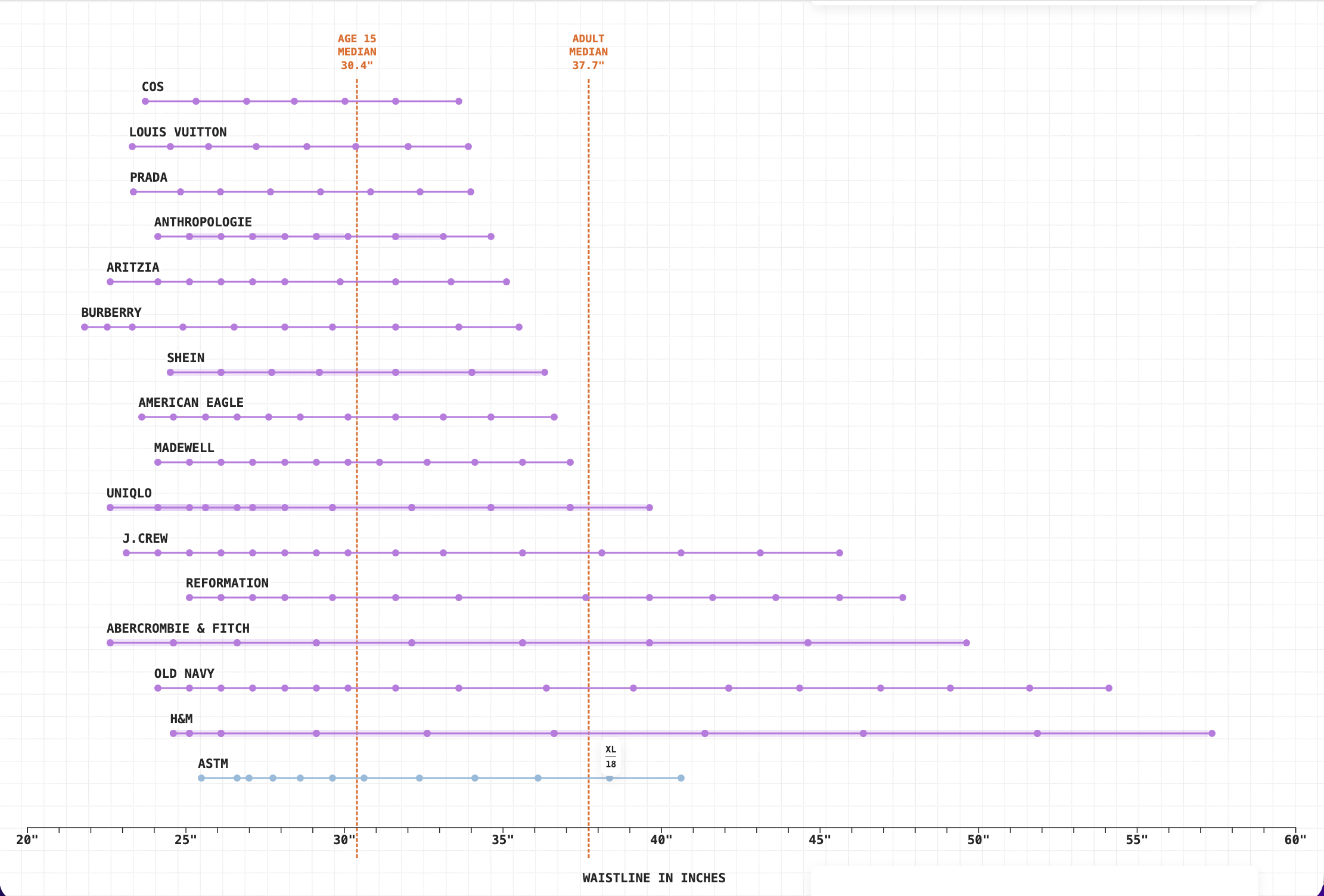
Fascinating. Let’s get down to business here on the showstopper chart, I suppose.
You collected data from well over a dozen different brands and compared it to the closest thing that we have to an international benchmark. It is just shocking how there’s no similarity between any two brands. We can get into some of the more nitty-gritty, on who it’s serving and who it’s not, in a moment. I just want to ask you a little bit about the data accomplishment that you did here. How did you get this information? And how did you pull this off?
It was all manual, by hand.
Oh, my God.
Most clothing brands list body measurements in their size charts. For women, the three main ones are usually the bust, the waist and the hip measurement. Just going to every single website and finding those measurements was a difficult process because there is no universal way for them to disclose this information. A lot of times, the size charts themselves were changing location on websites. The size charts were also unable to scrape in many cases because they were just embedded so deeply into the deep product detail pages that it just became a nightmare.
At first, I was like, “Why isn’t there a product that exists that tells you what a size is and what the translation is for across brands?” And there are a few companies that have been hired by certain brands, TrueFit comes to mind, where they market software for these types of brand comparisons and size charts. But the real problem is that these size charts are changing constantly. I think these brands are leaving as much wiggle room as they need to be able to make adjustments season to season.
Fascinating. It’s also interesting because some of these brands are related to one another. It’s so fascinating that you walk into a mall, walk to a store across the Palisade and for the exact same demographic, for the exact same audience, they just have drastically different sizing. And it’s just the way it is.
Even the same parent companies would have completely different size charts. I think that was one of the things that blew my mind.
That’s insane. What?
The Gap and J Crew could have the same parent company and even manufacturers, but they were tailoring their size charts to their supposed target demographics. That meant sometimes there were small inconsistencies, but usually it meant they were completely different systems.
That’s crazy. I want to talk a little bit about the crux of the story, which is a fascinating question about what exactly these size charts exist to do. You can see very abundantly that these brands do not serve the median adult woman.
No. And in many ways, it’s by design, and it’s been like that for decades. It’s just wild to think about how the size charts came to be in the first place. They were established in the 1940s based on mostly urban white women. No women of color were a part of any of the early size charts. They’ve just been evolving out of that amorphous list of measurements since then. Brands have found that it benefits them if they make their own unique changes or tweaks – some invent entire sizes on their own to have their own niche in the market. By and large, it’s been based on whoever they determined to be their target demographic. For the vast majority of time, that has meant not the average woman.
It’s also really interesting because there’s been change over time, as well.
That’s the most maddening part about it. I think that’s the thing that women often focus on: what is called “vanity sizing,” where the size on the label stays the same decade after decade, but the underlying measurements continue to change. It was born out of a marketing strategy — the psychology of what makes people actually follow through on purchases and get them to buy things. They found that if a woman needed to size up in clothing, a lot of times she didn’t really want to follow through on that purchase or buy anything. In worst case scenario, she’ll say, “Hey, this brand runs small. I don’t really want to shop here anymore.”
To offset that, brands started vanity sizing. Merchandisers really started vanity sizing, where they would change the measurements, but then keep the label the same to really try to entice people to follow through on those purchases. But it just creates an arms race where if one brand is doing it, then the other brands have to do it too. I don’t think anybody is happy with vanity sizing, both on the brand side and on the consumer side. It’s a system that has been perpetuating for the last four decades at the very least, simply because we’re locked in, and it’s hard to get an off-ramp now.
It’s really interesting. I thought it was very cool when you started folding in some of your knowledge of actual garment design and building it. I did not know this going into it: there are figures within the fashion industry that are held up as ideal, hourglass being one of them. You actually wrote about this really interesting study that just pointed out that this is completely inconsistent with the actual shape of human beings.
Yes. The high-fashion luxury labels have a very idealized vision of a woman and the type of garments that she would wear. And it’s very tied to, in my mind, the ’50s silhouette of a tiny waist and a slim woman. I think that has perpetuated throughout the industry, from how fashion students are taught in school to how brands act today. In school, when fashion students do design sketches, they do it in extremely out-of-whack proportions where the models that they draw are far taller than the average person, almost alien-like.
That has its ripple effects on how the basis of all of these clothes is made. The hourglass has been a continual basis for these size charts. In many ways, it is just a lingering holdover from the early 1940s version of the size chart that was originally created.
I really hope that folks dive in and check it out because it’s really illuminating. The garment industry is not small; people need clothes. It is an extremely large industry that appears to be sizing based on a fantasy. And that just strikes me as very inconsistent with every other business in America.
It is truly wild. I think the main question that often comes up, both for me and just in general, is why hasn’t there been a company that solves this market? The main problem was just the lack of consistency across the industry. A lot of brands are like, “Well, we don’t really dress plus-size women. That can be for a different plus-size brand.” So it’s pushed off to the margins. There are definitely incredible plus-size brands, but there are no consistent metrics of what the market is, who is being served or what these sizes actually mean. There isn’t that big-picture setback that these brands are taking on. You know, who’s being left behind?
Fascinating. What was your takeaway from this project as a whole?
Honestly, I’m hoping that it can start a conversation on these issues that have been around for decades. I think that the fashion industry has been at a turning point ever since the pandemic. Ever since, supply chains have really had a ripple effect in getting us the clothes that we usually see in stores, and the same with Trump’s tariffs. I think this could potentially be a turning point to re-evaluate the system that we’ve had, which for so long has been incredibly broken. And is it worth sticking with it?
Just clicking around within this is illuminating, even as a person who personally does not buy women’s clothes. It’s still a deeply, deeply fascinating set of data that you managed to pull off. I’m in awe of just how much work went into this.
I’ve been really grateful for the interest and also people earnestly engaging with the absurdities of it. For those who have lived through it, it’s just one of those things. It’s like, “Yeah, this is how the system works.” And I think it’s been really refreshing, at least for me, to be able to hear people be like, “Yey, this is messed up.” Yes. Great. I’m glad you’re saying that because I’ve felt this for a long time.
Where can folks find you and find your work? This was a really, really great story. What else are you up to?
Thank you. Yeah, I’m continuing a lot of this work. I’m currently doing a project where I’m making an entire custom wardrobe, or at least I’m attempting to, and documenting my journey along the way. We’ll see how it goes, but I’m hoping that we can give an in to talk about some of these bigger picture issues that are tied to garment making, like what we’re talking about: the impact of tariffs on the textile industry, labor costs and exploitation, sustainability.
I’ll be doing all that on socials. It’s called DIY Wardrobe, where I’ll be releasing the latest steps on the journey. But I’m hoping that it’ll be a similar thing where we can have an honest and clear conversation evaluating whether or not we actually want to stick with these systems.
Instagram for now, and then YouTube coming soon.
Thanks a bunch for your time. I really appreciate it.
Thank you so much.
Edited by Crystal Wang
If you have anything you’d like to see in this Sunday special, shoot me an email. Comment below! Thanks for reading, and thanks so much for supporting Numlock.
Thank you so much for becoming a paid subscriber!
Send links to me on Twitter at @WaltHickey or email me with numbers, tips or feedback at walt@numlock.news.

THIS is SUCH an AMAZING interview! Thank you Walt for bringing the brilliant and ground-breaking Amanda Sakuma forward! Her studies of the whole mishegoss of the fashion industry 'for women', considering how many women don't fit RTW mainstream clothing is so validating and reassuring. I'm excited to learn more from her YT channel. Fashion is such a touchy and frankly disturbing topic for those of us who hated ourselves bc WE couldn't find attractive clothing that actually worked for us. Like Amanda, I learned to sew my own stuff or tailor the pieces I loved in order to get through an active day.