
By Walt Hickey
Welcome to the Numlock Sunday edition.
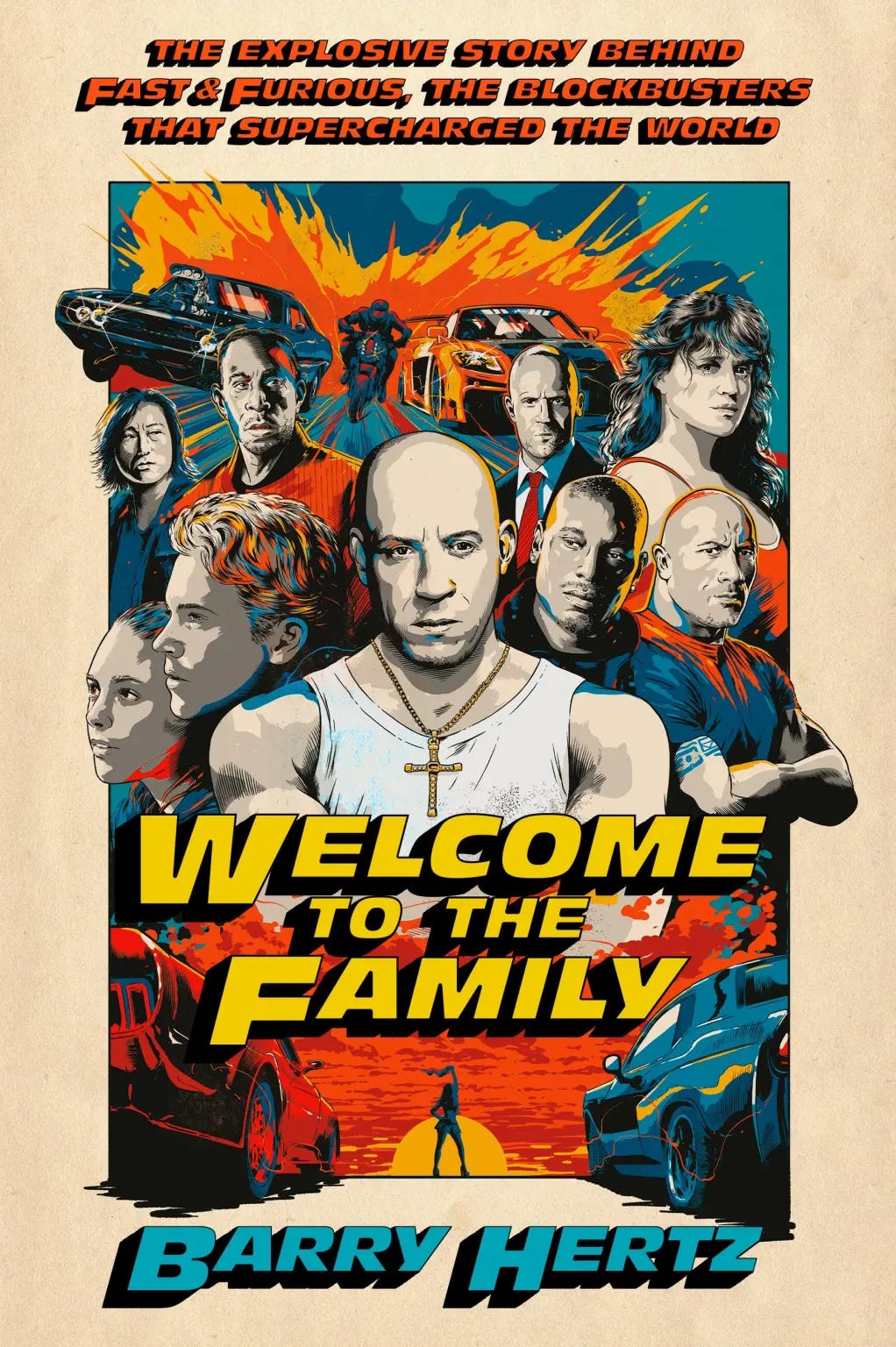
This week, I spoke to Barry Hertz, who wrote Welcome to the Family: The Explosive Story Behind Fast & Furious, the Blockbusters that Supercharged the World.
I am on record as a big fan of the Fast and Furious franchise, I find it fascinating and one of the most interesting ongoing works in studio blockbuster narrative filmmaking, and I was super excited for this book.
We spoke about how these movies changed the industry, the behind-the-scenes fiascos that defined their production, and how these things actually got made.
The book can be found wherever books are sold.
This interview has been condensed and edited.
Barry, thank you so much for coming on.
Thank you so much for having me.
You are the author of Welcome to the Family: The Explosive Story Behind Fast & Furious, the Blockbusters that Supercharged the World. I went to your book event in New York last week. And it was really, really delightful to see that launch here.
I know that there are obviously a lot of franchises that have a lot of eyeballs on them at all times. Things like Star Wars come to mind, Marvel comes to mind. But Fast and Furious is an interesting one because it is one of those quietly influential, deeply global, strange things that have evolved over time. What got you interested in writing a book about these folks?
I think you summed it up nicely. When we think about really the major franchises of our time and really of cinematic history, the top ones we have talked about to death in a way. There are tons of books about Star Wars. There’s tons of books about James Bond, Harry Potter, the DC Universe, Marvel. I feel like everybody who is really attuned to pop culture and to film-going knows a lot about those and knows the arcs and the evolution and the narratives that have gone behind it.
Fast and Furious has always been near the top for a quarter century now, since the first one came out 25 years ago. It will be celebrating its 25th anniversary this year. And yet, we don’t really talk about them in the way I feel that is deserved or should be appreciated. It didn’t start off as a Star Wars thing. It didn’t start off as an Iron Man thing where there was this big intellectual property machine behind it and playing with all these tropes that we know about the hero’s journey and everything.
It started off as this really small, gritty, street racing movie that was a B-movie intended once upon a time for spring break audiences as a here and there effort by a studio. Over the course of several years, thanks to various twists of fate and star ego battles and different business motivations, became this world-conquering phenomenon. I thought that the evolution of the series (just looking at it artistically as what these films are and what they have become) was interesting meat to chew on just as much as all the behind-the-scenes machinations of how this franchise is reflective of Hollywood ambitions and the Hollywood evolution of the business over the past 25 years.
Yeah, it was really cool to view these movies as comparable to Bond in the sense that Bond has a reputation where you can can trace the state of action filmmaking by comparing a Connery Bond movie to a Pierce Brosnan Bond movie to a Daniel Craig Bond movie.
The Fast movies feel like that with the past 25 years of filmmaking. How did these movies evolve from a Poiny Break ripoff to the top, top, top of action filmmaking in America.
That’s a great point because when the first movie came out in 2001, it was like this weird in-between era for action movies. We were edging out of the Schwarzenegger, Willis, Stallone heyday of the late ’80s and the ’90s, and we were in this mushy middle period. Michael Bay was certainly around there, but it was in Pearl Harbor, right? He was aiming himself in a more prestigious direction. Then we had the absolute dreck of the late ‘90s, early aughts of Chain Reaction and Mercury Rising and stuff like that — the instantly forgettable path.
Then there’s like this little shot of adrenaline with the first Fast, where it was very scrappy, it was very gritty, it was very obviously Point Break inspired. As the films grew and action cinema grew up a little bit, we were getting into that Michael Bay period of Bad Boys II. One of Fast’s longtime second unit directors who handled all the stunts and set pieces, Spiro Rosados, was on Bad Boys II. You can see that reflected in Fast Five onward, where there was this intense lineup of set pieces one after another — this avalanche of action that was increasingly exponentially explosive and ambitious and practical
As the Fast films get bigger and crazier, we’re in the land of going to space in F9 and blowing up Rome in Fast X. The CGI has taken over, much like CGI has taken over in a lot of the big-budget action movies of our time. What are Marvel and DC except efforts in creative green screen technology? That was also a fascinating track to follow.
It’s so funny that you make that point: at first, they’re clearly racing actual cars, and then it goes to they’re clearly blowing up actual cars, and then it goes to, well, they’re not blowing up cars anymore, they’re blowing up banks and buildings and that stuff. Then it’s like, well, they’re not actually blowing anything up anymore, it’s all CGI.
Yeah, that’s exactly it. And I feel like, I think you and a lot of Fast fans would agree, that Fast Five represents the pinnacle of not only that franchise, but also of contemporary action cinema of the 21st century. For my money, there isn’t another action movie that is as epic, as sincere in its desire to destroy things for real in front of your eyes — just delight and excite the eye with that shattered glass and twisted metal and smoke and fire.
The thing is that you can see in the human eye register when something is real and practical versus something that is created digitally. I think that was a real hard moment for it. Ever since then, the Fast films and Hollywood in general have taken the wrong lessons of what to do when it comes to crowd-pleasing action. They think just because we want it to be bigger, because we want it to be better and more absurd, things have to be rendered digitally for that to happen.
I went to a book event that you threw in New York a few weeks ago, and I’ve been thinking about it since. This is a Universal Studios film, which is only somewhat relevant to what I’m going to say. Jaws came out in 1975, 50 years ago, also Universal. As of right now, the exact midpoint of that start of the blockbuster era of filmmaking and today is the release of The Fast and the Furious in 2001. It does cleanly bisect what we consider to be studio blockbuster filmmaking.
Where do you place Fast and Furious as influencing what has happened since? What has it changed about how movies are made and how they’re not made and what goes into producing this thing?
Well, I think that there are a lot of things that really have changed because of the Fast and Furious franchise. I feel it was an inflection point in a lot of ways. First and foremost, in that everything can be a sequel or a spinoff and time is relative. There’s not one single character that has been in all of the films because of various contract disputes and so on.
Yet you have a brand identity that has carried it through. And we’ve seen Hollywood increasingly, almost now wholly, reliant on brand familiarity.
The other thing is that films have become so important for what the studio’s business interests are in a larger, almost geopolitical sense. They have expanded the market outside of North America, which is where a lot of movie studios now have to look to buffer their profits because North American audiences are just so fickle now. We’ve seen the Fast films make direct appeals to South America, to Europe, to China. I feel they were the first past the post on that idea.
The other important thing, just going back to the idea of Jaws and when the summer movie was birthed, the Fast films and the way Universal has released them have really changed the nature of the movie calendar as we know it. These films — when we think about them, we think about them as summer movies. And yet the first one was intended as a spring break movie until marketing inside Universal thought better of it to push it to the real summer.
Fast Four was released in April, and it had done so because it needed to take the spot of another Universal movie that wasn’t quite ready. But the marketing behind it was basically like “Summer starts early” or “Summer starts now.” So the summer calendar is now basically the entire year. Whenever a movie studio releases a big tentpole, that’s saying, “This is a summer movie, but we’re gonna release it anyway because the seasons don’t really matter.” I feel Fast was pushing that idea from the ground floor. We don’t go by the Gregorian calendar anymore. We go by Universal’s calendar. So when basically summer starts, summer starts.
I want to ask the extremely basic question: how are these movies made?
Marvel has a system that is a Kevin Feige-run operation. He’s got two lieutenants, and then they basically just alternate making the movies. The director is mostly there to shoot the people talking to the camera. With James Bond, obviously, the Broccolis are very involved in steering that direction, but nevertheless, each director is given a thing. The vibe that I get is that these are really Vin Diesel’s movies, in a way. You don’t really see an actor control production anywhere near as much as you see on these. How do these things get made?
The only comparable person or figure I could think of would be like a Tom Cruise who’s controlling and overseeing not only the mechanics of production, but the aesthetic qualities of it. And Vin did something very smart when he was implored to make that cameo at the end of the third film, Tokyo Drift: he negotiated, very candidly, producing rights on the franchise going forward. So that was his entry point into having this greater degree of control over where the franchise was going, more than any other actor has really exercised in such a major franchise.
As you say, none of the Bond actors really had a say over the Broccolis, and Daniel Radcliffe wasn’t telling Chris Columbus or anybody else how to direct the Harry Potter movies. So the house style has been very Vin/Don-centric. I mean, he is the Kevin Feige of Fast.
At the same time, I do feel I feel this was borne out in my reporting on it: it is not Vin at the top making single-handed decisions. It is like a three-headed beast, if you will. Universal is very invested in the financial success of this. You have the Universal executives on one side, you have Vin on the other, you have whatever director has been roped into it and has to imprint their own vision, balancing out these larger competing forces. Then you also have longtime producer Neal H. Moritz, who has been on this series from the very get-go.
So it is a balancing act, and you can see that struggle to please everybody or to get everybody’s input and make it work, especially in the later entries of the franchise. I’m thinking films seven and eight in particular, a lot of cooks in the kitchen. It is a miracle because of the size of this and because of the egos and personalities involved that we’ve even made it to parts 10 and 11, if you want to count Hobbs & Shaw.
That’s really interesting. It does seem like you get a sense of the cooks in the kitchen element of this, absolutely.
In that regard, to see the flip side of that coin, there are a lot of people who make these movies, and you talk to a ton of them — some background, some on the record, things like that. You talk to the stunt teams, which I thought was super cool. I was interested in who some of the most interesting folks are and some of the coolest stories from the production of these films. Beyond the above-the-line dramas (the things that spill into The Hollywood Reporter), it seems like it can be a lot of fun to make these movies.
Oh yeah. Making these movies is an intensely hard job. You’re away from your family for months at a time. You’re often doing very dangerous things, especially on the stunt side of it all. But you are being paid to go to exotic locations and just blow stuff up, have a blast. One of the characters I spoke to, it was so refreshing and rewarding to hear his perspective on it, was Spiro Razatos, who has handled second unit filming (the stunt unit basically) on the Fast films ever since part five.
That’s sick.
He’s quite a character. He grew up doing his own homemade stunts in a proto-Jackassian way, filming himself getting lit on fire, crashing, jumping off roofs with nothing but a few cardboard boxes to cushion his fall. He made a name for himself in the B or C-level Hollywood ecosystem, working on titles like Maniac Cop and stuff like that — direct to HBO, back when HBO was not a prestige brand type of movies.
Then he graduated to this level of vehicular mayhem. Hearing him talk about the efforts and ambitions and time, once in tears, that would go into creating these set pieces — the vault scene in Fast Five, or the Iceland stuff in Fast Eight with the orange Lamborghini on the ice and the tanks and the nuclear sub. It just blows my mind that he hasn’t died several times over or been responsible for the deaths of scores of people. That was a wild series of discussions for sure.
Part of writing the book was, in fact, because a lot of those public beefs between the top-of-the-line talent are well known. I wanted to highlight some of the lesser-known stories of the workers who come every day, clock in and risk their lives in trying to make a very entertaining, explosive movie.
It’s fun to hear those stories. I really dug it. You’ve been very generous with your time. Where can folks find you, and where can they find the book?
You can find me; I’m online almost everywhere. I work as the chief film writer critic for the Globe and Mail newspaper in Toronto. You can find me there. “Barry Hertz Globe and Mail,” Google that, you’ll find my author page and all my many, many articles. Online, social media-wise, I am @HertzBarry almost everywhere: Twitter, X, Blue Sky, Letterboxd, Instagram.
You can find my book, Welcome to the Family: The Explosive Story Behind Fast & Furious, the Blockbusters that Supercharged the World, wherever you buy your books, your audiobooks or your eBooks. However it is most comfortable or convenient to purchase those, you can find them there. So please pick up a copy and enjoy the ride.
Edited by Crystal Wang
If you have anything you’d like to see in this Sunday special, shoot me an email. Comment below! Thanks for reading, and thanks so much for supporting Numlock.
Thank you so much for becoming a paid subscriber!
Send links to me on Twitter at @WaltHickey or email me with numbers, tips or feedback at walt@numlock.news.
