
Welcome to the Numlock Sunday edition.
By Walt Hickey
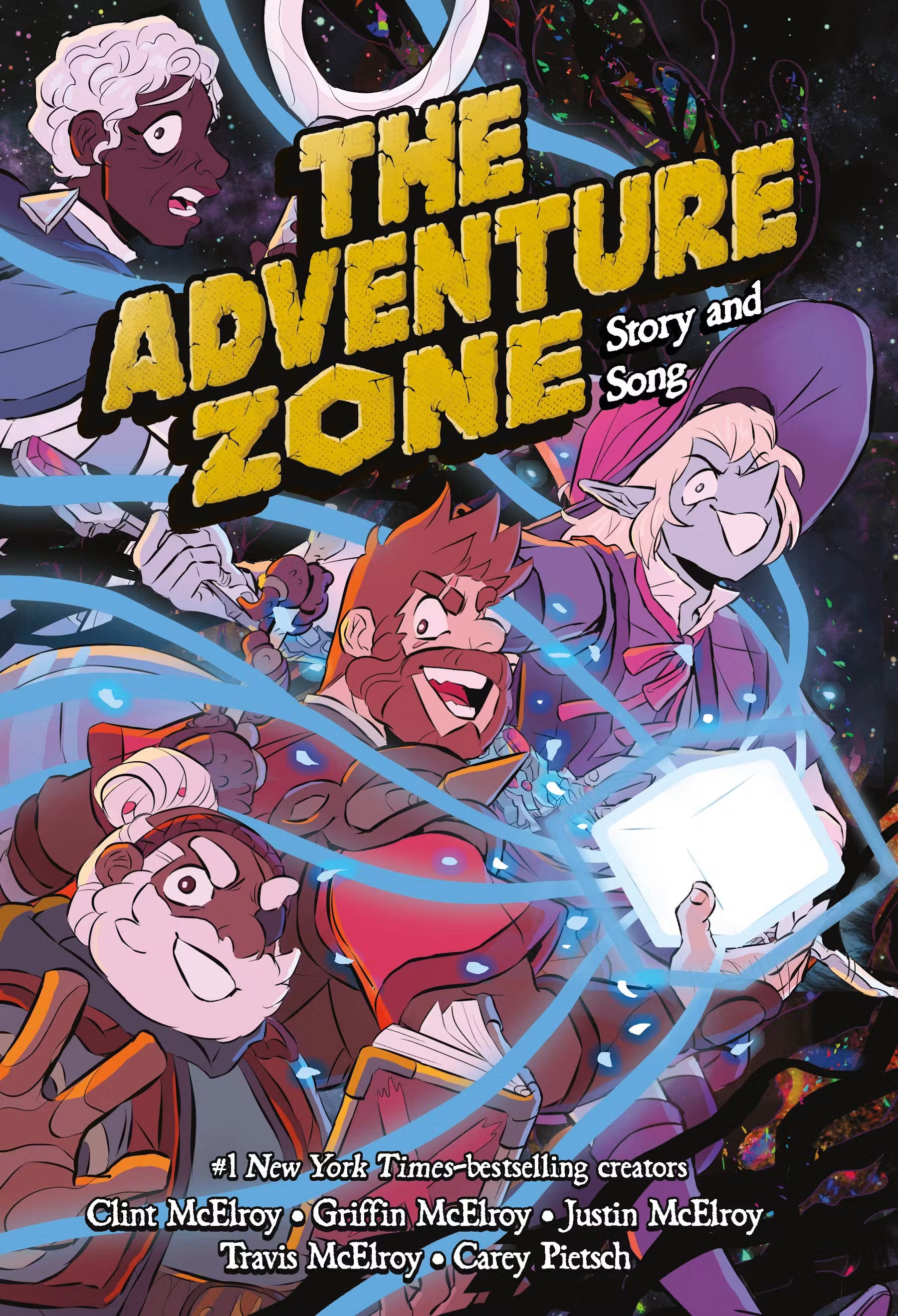
Very fun interview this week as I speak to the phenomenally talented artist Carey Pietsch, whose work illustratingThe Adventure Zone series of graphic novels concluded this week with the release of The Adventure Zone: Story and Song. I was a big fan of the podcast upon which these books are based and I love this series of graphic novels.
Carey’s work on TAZ was trailblazing; I am fascinated by these books in no small part because it’s an adaptation an a novel use of a novel medium in a novel medium; none of the parts of of the phrase “adapted a hit TTRPG podcast into a mass market graphic novel series” existed twenty years ago, and now they are huge, and these books were a key reason why.
Carey can be found at careydraws.com, and you can find the comic The Adventure Zone: Story and Song anywhere books are sold or at theadventurezonecomic.com.
This interview has been condensed and edited.
Carey, thank you so much for coming on.
Thank you so much for having me. I’m so excited to get to talk with you.
You are the artist behind the Adventure Zone series of graphic novels. The final book in that series comes out this week, Story and Song. It is the culmination of years of work on your part. How does it feel to bring this project down for a landing?
Wow, I don’t want to consider exactly how many years it’s been because I think I might turn into dust and blow away on the winds. But it really has been almost a decade of work, which is terrifying to look back on, in retrospect. All of us are just so incredibly proud of the way the final book turned out, and we also feel so incredibly lucky that we got to make a seven-book series adaptation of the TAZ: Balance podcast in the first place.
It is a challenging time for publishing overall, and making a series is never guaranteed, let alone one this long. At the start of the project, we had only signed up for two books, and I think it was very easy to say, “Oh, sure, we’ll get to make two, and then who knows if we’ll ever get to continue on to the end of the arc.” But by the time we finished the first one, we were all so completely locked in with, I think, the fever and need to keep going, that it was just a delightful surprise every time when we finished a book and the publisher somehow said yes. I say somehow, but it’s really the support of the readers that allowed them to keep bringing us back to do the next one, and the next one, and the next one, until we finally made it all the way to the end.
Yeah, I want to dive into a lot of the changes that you’ve seen.
For folks who might not be totally familiar, this is one of the most unique books out there just by virtue of where the story comes from and how it was created. This was a very seminal podcast. This was one of the first tabletop RPG podcasts to be very successful, if not the first that really got wide mainstream attention. This was the first graphic novel adaptation of them. Do you want to speak a little bit about where the story came from, what the story’s about and what these books are?
TAZ was my entry point personally to the live-play TTRPG podcast world. I think now, if we’re coming to the genre today, Critical Role and Dropout’s D20 are probably the first two big ones that you hit, but over a decade ago, my entry point was TAZ. My other favorite from that time that I still love dearly is Friends at the Table, whose Marielda campaign is a great standalone entry point, but I came to listen to The Adventure Zone in mid-2015.
At the time, I was tearing through inking a different comics project, and I was listening to a ton of podcasts to survive it, and a friend put me onto TAZ, and I was just immediately hooked. I think part of the appeal is obviously the story, right? This is four professional storytellers, professional comedians, improv actors. And they obviously are also family, so they know each other really well. Part of the appeal is getting to hear the story that they’re all building together, but the other piece is that it’s just immediately apparent that these four guys are having a great time. They are having fun together, they’re following each other where they want to take the story and also their characters, and I think that combination of really charming interpersonal chemistry with a really compelling story was what got me hooked.
The way that the McElroys pitched TAZ is the story of four fools who played Dungeons & Dragons so hard that they made each other cry. But to me, the core of this story is this balance of comedy and drama and joy. I’m a big Terry Pratchett fan, and that’s the fantasy that really appeals to me, something that uses a heightened setting to tell a story that’s ultimately about human emotion or self-emotion, personal emotion, whatever the case may be.
TAZ really hooked into the part of my brain that’s excited about comedic and lighthearted fantasy that has this core of being in this to tell you a good story, and we’re going to have a great time along the way.
That Pratchett connection is amazing, because I love the TAZ podcast , I love the TAZ books, and I just read all of Pratchett recently, and those books were a miracle. They’d been on my radar for years, and I’d never gotten around to them, and they are now very much contending for my favorite book series ever.
Your contributions to the book, you did all this magnificent art on it, you did the colors on this thing are amazing. How do you translate this audio fantasy realm into visual storytelling?
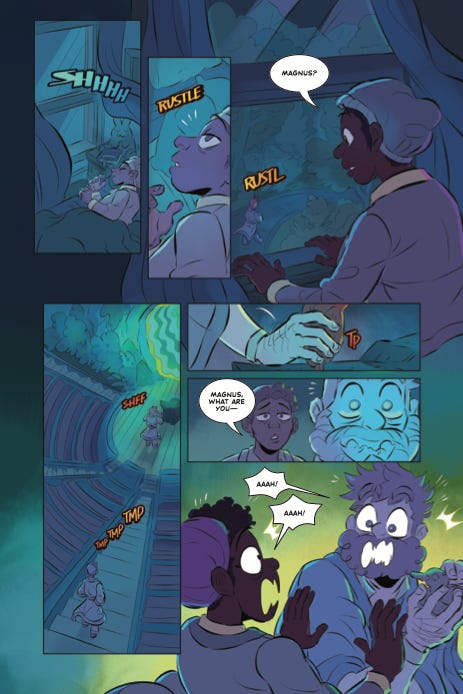
I think translation is absolutely the right word for it. There’s already so much information in the podcast, not in just the audio descriptions of the world, but in the voice acting, in the music that Griffin McElroy composed for the show. The way that they are talking with each other around the table also gives you more information about how the characters feel about the world. All of that is this really strong starting point for what the feeling of the world is.
A lot of sitting down to design the visuals and talking with the McElroys about what the visuals for the comics would look like starts from that point of re-listening to the podcast, reading the first draft of the script and thinking about how to translate the sense of tone, emotion and place that you get from the podcast into a visual realm.
That translation is also really collaborative. We all sit down and talk. I should define who I mean by all: the original editor on this series was Calista Bell. She was the acquiring editor. She was a huge fan of TAZ, the podcast, as am I, obviously. She was a big part of why McMillan picked it up in the first place. After book two, Benjamin Wilgus came on as our editor. He’s also a huge TAZ fan. He’s also a comics writer and cartoonist. Calista on the first book, Ben on the second book, me and all of the McElroys sit down at every stage to talk like “Okay, here’s everyone’s priorities from the art. Here’s what the McElroys are thinking in terms of what they want to keep, what might be able to be jettisoned. Here’s the first draft of the outline. How are we feeling about this?”
I would then, after that first sit down, go back and listen to the actual podcast alongside reading the script and start to make notes on what we know we need to design that’s actually going to be in the book, what research do I need to do to give myself a stronger visual vocabulary that I can draw on to build that design.
TAZ is set in this middle ages European fantasy setting, except that it’s much more about what looks fun and cool than about what’s period accurate. A lot of that research eventually gets thrown out the window. Like I think it would be really cool for this character to have a cape even if that’s absolutely not accurate to what someone in this class might be doing at the time. A lot of the translation is done at that early stage of talking about that feeling you get from the podcast and how that translates into the character designs we all talk about and the setting we all talk about.
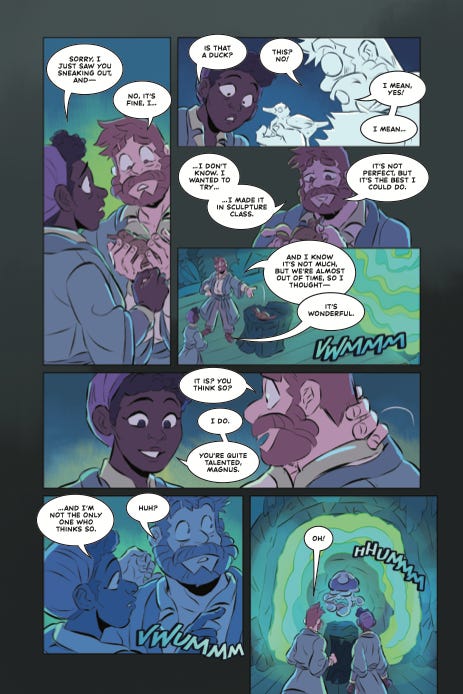
One of the more interesting parts of that translation in terms of challenge is what aspects of the podcast are not present in a comic? A big one is table talk and voice. That was a big thing when we sat down at the start. How much of these comic adaptations are going to be the characters that they are playing literally talking to the McElroys at a table versus what we eventually landed on, which is having the game master, the GM, as a metatextual insert that some characters can interact with and some can’t. That’s one piece is how do you translate table talk, which you can’t really do in a comic, into a comic.
The other really interesting challenge is the music. The music in TAZ is really, really beautiful and a huge part of the podcast’s appeal, especially around Crystal Kingdom when Griffin McElroy started making original compositions for the series. That’s obviously a tool that we don’t have in comics at all. I cannot do a Fisher Price listen and learn adaptation where you push a button on page 300 to hear the beautiful tones from the original podcast. As much fun as that might be, there is no budget for it and the logistics would be a nightmare.
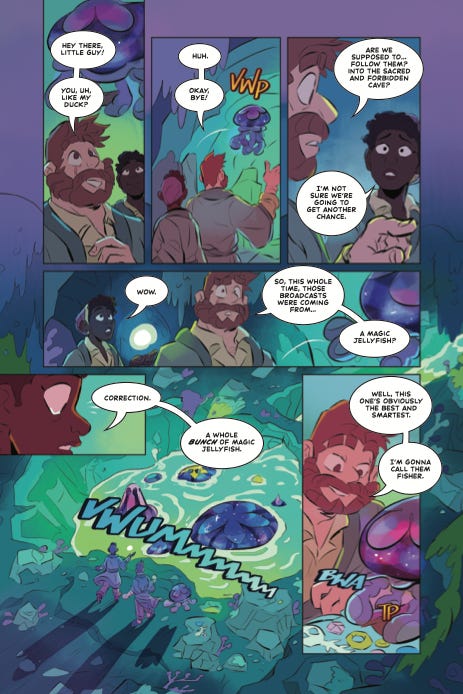
Instead, you have to think about what this song is doing emotionally, tonally, plot-wise in the podcast. What feelings is it creating in the listener? Then how can you translate that purpose into comics form? Again, obviously, you don’t have that same tool set. You don’t have music, but what you do have is the toolkit and language of comics and the way that paneling, pasting, both the general structure of a page and the structure of panels within a page, both their size, their placement, their rhythm, whether the borders are angular or regular. You can use all of that toolkit to create a sense of rhythm and timing and rhyme in a way that really is a translation or an attempt to translate the feeling of the music with a totally different toolkit.
Yeah. I love that you pointed that out. I think that a lot of the work, particularly when it gets very kinetic aspects; obviously, there are moments in tabletop RPGs that are just people talking and trying to pick locks and then there’s combat. The ways that you actually accelerate the pace of reading just by what you do with the panels is really good.
As a reader, when watching a comic artist work on a project for seven years, not only do you watch the work evolve, but you watch them evolve. You watch them pick up some new tricks and that stuff. I think that this is your most visually ambitious work yet and just looks astonishing. Really, really, really good.
Thank you. For me, it has also been really exciting to have this visual record of my growth as an artist over time. I talk a lot jokingly about the TAZ GMs being my co-adapter and artist dissertation project, but it is also a dissertation where you are co-working with four, five, including our editor, complete geniuses. Not only are the McElroy’s all storytellers, all comedians, all actors, but they also have really specific skillsets that they brought to this adaptation that I learned a ridiculous amount from.
Clint wrote for comics long before TAZ and that meant he has not just this library of innovative, really fun, unconventional sound effects, but he also has all this experience with dialogue and pacing and plot. Obviously, Griffin McElroy was the GM for the TAZ Balance campaign. And that gives him this unique look at a story from beginning to end and the most care in crafting the big arcs of it, in addition to the improv and flexibility to adapt that into another medium and see how it changes knowing how it ends. Plus, he’s written in other mediums. He’s just incredibly good at big structural stuff.
And then Travis has a really good sense of not just character voice and being true to a character’s voice, even when the details of what’s happening are slightly different, but also how to connect the adaptation back up to the podcast original tone. Justin, he is so good at being able to spot a dialogue problem and immediately come up with a fix that not only is like, “Oh, this is pretty good,” but also is natural and it’s funny and it’s fun.
When Ben and I would talk about the thumbnails with the rough lettering in place before we kick it to the rest of the team, we’d both be like, “This dialogue isn’t working. We don’t know how to fix it. We’re just going to kick it to the rest of the team and Justin’s going to handle it.” And 99 times out of 100, he did.
That was a long pitch, a long way to ramble back around to say that it is impossible to encapsulate everything that I’ve learned over the course of making this project because making comics is a long course in learning how to do something new every day of your job. That’s part of why I love comics in the first place. You get to wear so many different hats and develop your skill in so many different tasks over time. But also in this case, this was an incredibly rare collaboration where not only did I learn something from my collaborators literally every time we sat down to talk about the book, but they also made it fun, which I think is really difficult to sustain over the course of an eight-year, I-don’t-want-to-count-how-many-page project.
But it was just a complete delight from beginning to end, which is part of why I wanted to sign on in the first place. But more importantly than that, that’s why we all kept it going, right? These are books we got to have just an incredibly joyful time making together along the way.
I’m so glad that you brought up Clint McElroy, the family patriarch, who had made comics in the 80s, because I was going to ask about that. He worked a bit for NOW Comics back in the day. And since you started working on this project, he has gotten back into the game, and they’ve done some work for a Thor event a few years ago. He is a bit of an old hand on this. I was wondering how it was to work with someone who had been from a different generation of comics production, how that was.
It’s great. Honestly, it’s fantastic. He has a great sense of not just writing, but writing for comics. For prose authors, authors coming from other mediums, it takes a while to adapt to not just the standard. You can only write one action per person, per panel, or else your artist is going to throw you out a window. How many words can fit in a dialogue balloon before it feels overcrowded? How many words can fit on a page? How do you make sure you’re leaving room for action? His background gave him that skill set in action comics and drama comics. And in translating that into a longer graphic novel format, he really brought his A-game in terms of making sure that from minute one the script was ready to go.
Just one last question before we wrap up. The thing that I really, really love about this project is that it was very much ahead of its time in so many ways when it launched. You’ve seen other projects come into this fold, but the main thing that I’m obsessed with is that its graphic novel series based on a tabletop role-playing game podcast. If you said that sentence as recently as 2007, you would have been committed. That just simply did not exist as any form of genre or medium for that. What has it been like to blaze a little bit of this trail?
I sound like a broken record, but I feel so incredibly lucky to have gotten to be a part of this project because it really was combining podcast, which I have no experience in, but love dearly listening to and which kept me company drawing a lot of earlier comics projects, with a medium that I think is so cool for its flexibility — its heightened reality, its ability to use color in a non-literal way and character design in an excessive, exaggerated way to convey to you emotions and tone that are difficult to do in any other medium. So getting to combine those two things is really exciting.
I am so stoked now that my work on it is done, I finally get to go read all of these other TTRPG comic adaptations that I took a stance of “I don’t want to read these right now.” I am so excited about them, but I don’t want to get in my own head about what other genres are doing or what other adapters are doing. In the same way that I had to take a big step back from looking at TAZ fan art and being a part of that fandom. So now I have this buffet in front of me.
Like oh my God, there’s so much I can catch up on. I’m excited about the Fantasy High webtoon. I haven’t gotten to read any of the Critical Role comics. And I know that the Kickstarter just launched for Jadzia Alexrod and Sarah Webb’s adaptation of The Wizard, the Witch, and the Wild One, and I love Sarah Webb’s cartooning so much. That one is immediately, like, the first thing. Give it to me. I want to read it right now.
Wow, I’m so jealous. Even the fact that you had to cool off on fan art for a bit, that takes a lot of discipline, but you got a feast ahead of you.
Right, this is the marshmallow test writ large. Now everything has a chance to blossom and explode, and I get to go read it all, and I’m so excited about it.
Amazing. All right, well, Carey, so the book is out. It is The Adventure Zone: Story and Song. Why don’t you tell folks where they can find it, where they can find you, what you’re working on.
So the book is out in stores everywhere. You can find it at theadventurezonecomic.com or wherever books are sold. I am currently working on an unannounced project with Abrams Fanfare. It is a middle grade original graphic novel that I just handed in my script draft for, and I am so stoked to get to talk more about it soon.
I think by the time this interview comes out on the 19th, we will be done with all of our big launch events, but I will be at Small Press Expo in Bethesda, Maryland in mid-September. And I love talking about comics, so if you see me there, please come talk with me more about comics. I always love getting to do that.
Awesome.
What am I missing? Oh, you can find my work at careydraws.com, and that’s my handle on the social media that still exists at the time this interview goes live.