
By Walt Hickey
Welcome to the Numlock Sunday edition.
This week, I spoke with Christian Elliott, who is out with a great new article called Lessons of a landslide detective in National Geographic all about the glacial collapse, Alaskan landslides, and the detective-geologist trying to save the state. Here is what I wrote about it:
Geological instability is of specific concern in Alaska; retreating glaciers, permafrost thaw and intense weather are causing more frequent landslides. Studying landslides is hard and predicting them even moreso. Getting the resources and monitoring equipment out in the field can face local opposition as a desire to learn what the ground is doing is overwhelmed by what knowing this information may do to property values. In Alaska, geologist Bretwood “Hig” Higman has worked to study these shifting landscapes through inexpensive, widely deployed radar instruments. They are enclosed in mason jars to deter animal interference and enter the field at about $300 a pop, and are now monitoring over 50 slow-moving landslides.
I’m such a huge fan of Christian’s work, and he’s been doing some boots-on-the-ground science journalism that we often cover at Numlock. You can find his work at at christianelliott.me.
This interview has been condensed and edited.
Christian, thank you so much for coming back on. I feel like you were just on recently to talk about your amazing story about prairie graveyards, but this story was so superb that I just wanted to have you back. So, thank you for your time.
I appreciate it. Thanks, Walt. This is definitely a different one, but I’m pretty excited about it.
Yes, very different part of the country. In this story, you go to Alaska. You profile a fascinating geologist working on a very interesting problem. You talked about some of the more charismatic landslides that have gotten attention, but why don’t you talk a little bit about the big picture. What’s going on in Alaska when it comes to landslides, and why is this of particular interest?
Not to put it too dramatically, but Alaska is basically falling apart. It is unfreezing. The permafrost is thawing. The glaciers are retreating at a really remarkable rate, and a lot of the geology in Alaska, the mountains, are made of fairly weak rock, and especially as the glaciers retreat, they leave behind these really steep slopes that were held up by ice previously and now are not. We are seeing this trend where those really steep cliffs that can’t hold themselves up on their own are starting to collapse.
A lot of them are moving really slowly, like creeping along, and then all of a sudden they can fall all at once. We’re talking about huge volumes of rock, like entire mountainsides. I think one of the best comparisons I was able to come up with was 24 pyramids of Giza.
Oh my god.
Great pyramids of Giza. It’s just hard to wrap your mind around, but these things can fall in like a minute, and if they hit water—like the water of a fjord, since glaciers tend to terminate in the ocean in these fjords—they just displace all of that water all at once, and you end up with these really huge waves, like taller than the World Trade Center, that can sweep down these fjords. Yeah, that’s really bad news if you live there or if you’re in a boat when that happens. Obviously it’s a very low probability, high consequence event. But scientists think that these are becoming more frequent, and that’s something that we need to be concerned about if we are in those places.
Yeah, and on that point, those waves are massive, and obviously we haven’t necessarily seen video evidence of them, but they have happened, and they’ve happened somewhat recently, right? There’s actually direct evidence of some of these large tsunami-style events that are a result of these landslides. The thing is that they just happen in places that are so remote that we don’t see them, right?
Yeah, and that’s partially because Alaska is huge and fairly sparsely populated. But yeah, we have seen these waves. There was one in 2015 in a fjord called Taan Fjord that was absolutely massive. There was a wave just last year in Tracy Arm Fjord that was the second largest tsunami wave ever recorded. And before that, there are just sporadic accounts. There was one in the 1950s that was huge. That still is the record for the largest tsunami ever. But they’re much closer together than they ever were before.
And at the same time, we’ve got a huge increase in cruise ship tourism to these fjords to Alaska. People want to go see these glaciers before they’re gone. The fact that the glaciers are going away is what’s causing the increase in risk from these landslides. The timing has not caused any fatalities yet, but a lot of scientists think that it’s a matter of time before something happens at the wrong time when there is a 4,000-passenger cruise ship in one of these fjords.
Well, let’s talk about one of the scientists. Let’s talk about Bretwood “Hig” Higman. He is the subject in many ways of your piece beyond the broader subject matter. And he is a fascinating dude. I was wrapped with attention when you were describing his work and almost like wildcat-geologist style stuff. Can you talk a little bit about him, his work, and where he fits into this picture?
Yeah, I was so lucky to find Hig. I ran into him back in 2023 when I was in Alaska doing a story on your more standard seismically-generated tsunamis. And he just came into this community meeting I was in and blew it up and annoyed the federal scientists I was there following. And I was like, “Who is this guy?”
He is a PhD-trained geologist who is from a little village in Alaska and has gone back and lives there. He is not affiliated with a university or a government agency. He is like this free-range geologist. He has gotten really fascinated with these giant bedrock landslides over the last like 10 years and has made it his mission to study them and better understand them because there are a lot of things that scientists don’t understand about how they work.
And also he is really motivated by trying to protect people from them, so raising awareness in these communities. He has made these cheap sensors on his own that live in mason jars that he puts out on landslides to try and get communities’ data because there is not really an agency that is monitoring landslides at scale and warning people about them.
When I learned all of that, I was like, “This is the guy to tell this story through.” It’s a little fraught to be one man against the world, but that works really well as a magazine story, and it’s true in Alaska. There’s lots of people working on this, but Hig is very unique among them.
Yeah, I had heard a little bit about some of the landslide issue in Alaska to an extent, and I think that a lot of people who had heard about it, myself included, heard about it through a New York Times story that really talked about Barry Arm, and that was an issue that made it go national. And he was the guy who was able to get the information to the Times. Barry Arm has also then subsequently attracted a lot of the attention around this issue, but it’s only one of many glaciers.
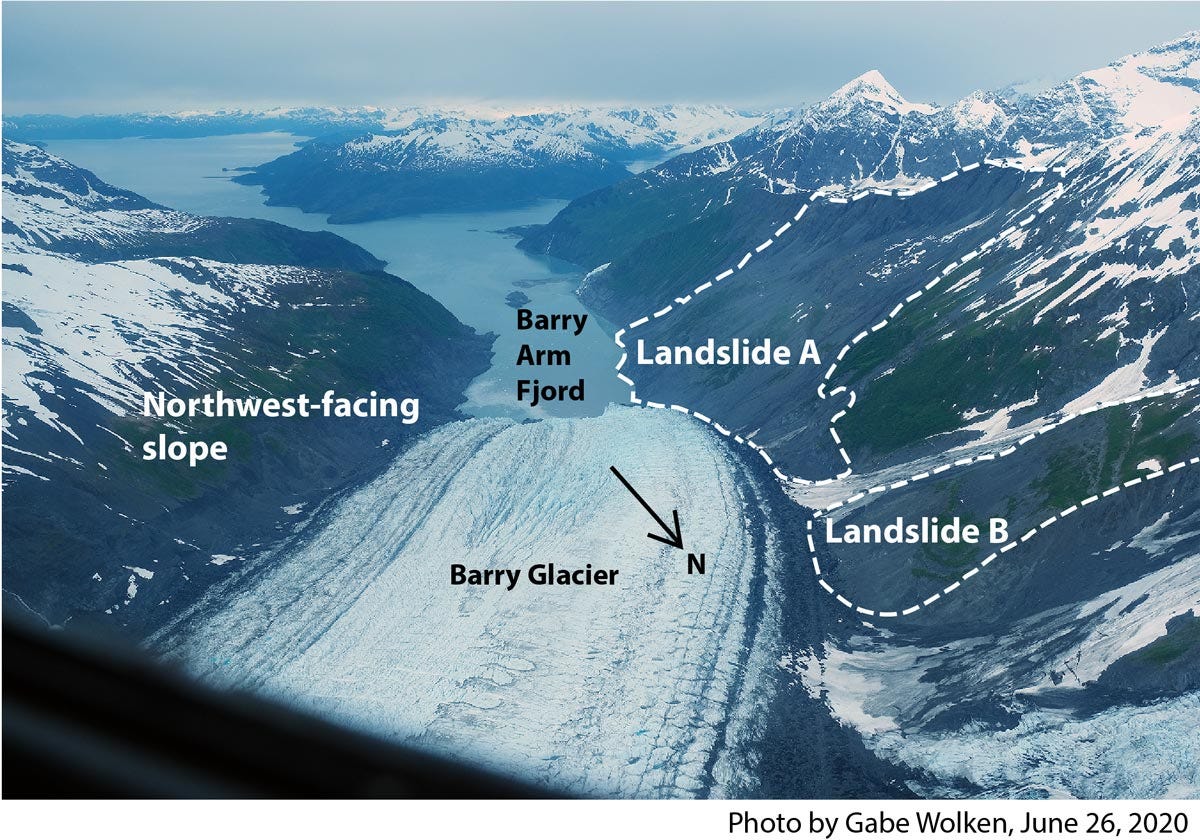
Do you want to talk a little bit about this rather charismatic future landslide?
Yeah, so Hig really is the origin for Barry Arm. He sounded the alarm about this creeping giant landslide that could generate a really big tsunami wave, and this is a rare one where there is a town, a coastal town called Whittier, which is also an interesting place. It’s like a former-secret-military-base-turned town, and there’s like a big American Samoan population there.
Is that the one with like one building?
Yeah, it’s the town that is famous for everyone living in one building. Not everybody lives in that building, but most of the town and town facilities do live in that building, and I went there for this story and talked to some people. It didn’t make it into the piece, but very, very unusual place and at risk for this landslide tsunami. But yeah, this one landslide, since Hig took the news to the New York Times, it got huge attention. Congress set aside money to study it. USGS had to scramble to figure out what to do about it.
I got to go out to the landslide with the USGS, another thing that didn’t really make it into the story in a narrativized way, but they flew me in a helicopter up to the top of it. We landed on it. We got to look at all these instruments that they’ve put millions and millions of dollars into studying and monitoring this landslide.
But Hig is like, “I messed up,” because all the attention has gone on to this one landslide like it’s a unique problem. But everywhere you look, there are very similar landslides across Alaska that have this tsunamigenic potential, and none of those are monitored really at all, but certainly not to the same extent that Barry Arm is. It’s like we’ve gotten stuck on this one landslide that has all this infrastructure on it that needs to be maintained, and there aren’t the resources to expand to the scope of the problem, which is much larger than this one landslide.
I was really interested in that part, the instrumentation element. You wrote about how the government dumped like $4.5 million a year into assessing this landslide hazard. They’ve got like a battery-powered solar array that records radar instruments on Barry Arm. And then everywhere else in the state, it’s a lot of just instruments that Hig has like improvised together when it comes to mason jars and radar equipment.
Yeah, very much so. I mean, part of it is just, it’s really hard to do this in Alaska. You’ve got very narrow windows where there’s weather that you can fly helicopters in and do field work in. Instruments get buried in snow for much of the year. It’s a real phenomenon. I did put this in the story that bears destroy instruments. There’s studies that study the degree to which bears like walk by, and they’ll chomp it. Then your instrument’s broken and you have to wait for the rare moment when you can go and replace it. So doing the science and monitoring it all in such a place, in a place with extreme weather, is hard and expensive.
And this is all happening at the same time when, as we’ve heard for the past year, these government agencies are losing tons of staff. They’re having their budgets slashed. It’s becoming more and more difficult to do really anything, much less expand a research program like this.
It’s a great story. And again, it’s in National Geographic, which I mean, hot damn, that’s great, man. That’s a great magazine for this. It’s gorgeous. It’s got amazing photographs. I would highly encourage folks to check it out and subscribe and give it a look, see if they get a shot, just because it is a really strongly visually done one. I guess just to wrap things up, where did you come away from this story?
I mean, obviously the need for more resources is acute. We’ve seen, though, in this case one guy, Hig, is able to single-handedly motivate people. Even if that just means blowing up one community meeting at a time, it was interesting to see what one very devoted scientist is able to accomplish.
Yeah. I mean, I think Hig is super important. I mean, he is a truly crazy guy. He seems to not ever run out of energy, and he is willing to spend his entire life traveling around doing this for basically nothing. But my central question driving this story was, with the political context of 2025 when I was reporting it, is this a way forward? Like can we do grassroots science and preparedness like this if the government has decided they’re not going to do it anymore? And I think the answer is no. There are not enough Higs in the world. He’s making a huge difference, and he’s pushing government agencies to do more by being so annoying to them, really.
The other thing that was really interesting, too, to just hop on that real quick is that, it’s not just enough to identify the problem. He realized that you need to convince residents that it is in their interest to actually study this even if it means insurance premiums going up.
Oh, yeah, 100 percent. We’re also living in a time when trust in science is low and trust in government agencies is low. And I think Hig has a huge advantage by being this like trekking folk hero in Alaska. He’s walked across the entire state, like 4,000 miles, including in winter. People know him from that. So when he’s coming into these communities, there’s already some level of at least understanding and trust of him that outside scientists and journalists don’t have. So that helps a lot.
But he still runs up against people who don’t want to hear about this. People don’t want to hear, “I’ve lived here for 20 years, and now all of a sudden there’s this landslide that could take my house out.” And what does that mean? Could I ever resell my house? And can I get insurance? And what should I do? Is that going to dominate my life and thinking now, or do I just ignore it? Those are real questions that apply to anywhere that’s facing climate hazards all over the world. So I think there’s a deeper question there.
Yeah, that deeper question, I think, is hanging over the piece the whole time, and I found it deeply interesting because this is not the only place that is undergoing rapid shifts in what is not a viable property for the next 100 years. Super interesting stuff, man. Where can folks find you and where can they find the story?
They can find the story in the June print issue of National Geographic. Highly recommend you pick it up in print if you can, or subscribe to the magazine as a vote of confidence that this journalism is worth doing. And if not, you can also find it online. It’s just behind an email gate, so you can put your email in and access it. And I am at christianelliott.me, all my work is there and you can find me and get in touch there.
Thanks a bunch.
Thanks, Walt.
Edited by Crystal Wang