
By Walt Hickey
Welcome to the Numlock Sunday edition.
This week, I spoke to the brilliant Eben Novy-Williams of Sportico, who also writes the great newsletter Club Sportico. Here’s a recent story of his I included in the newsletter:
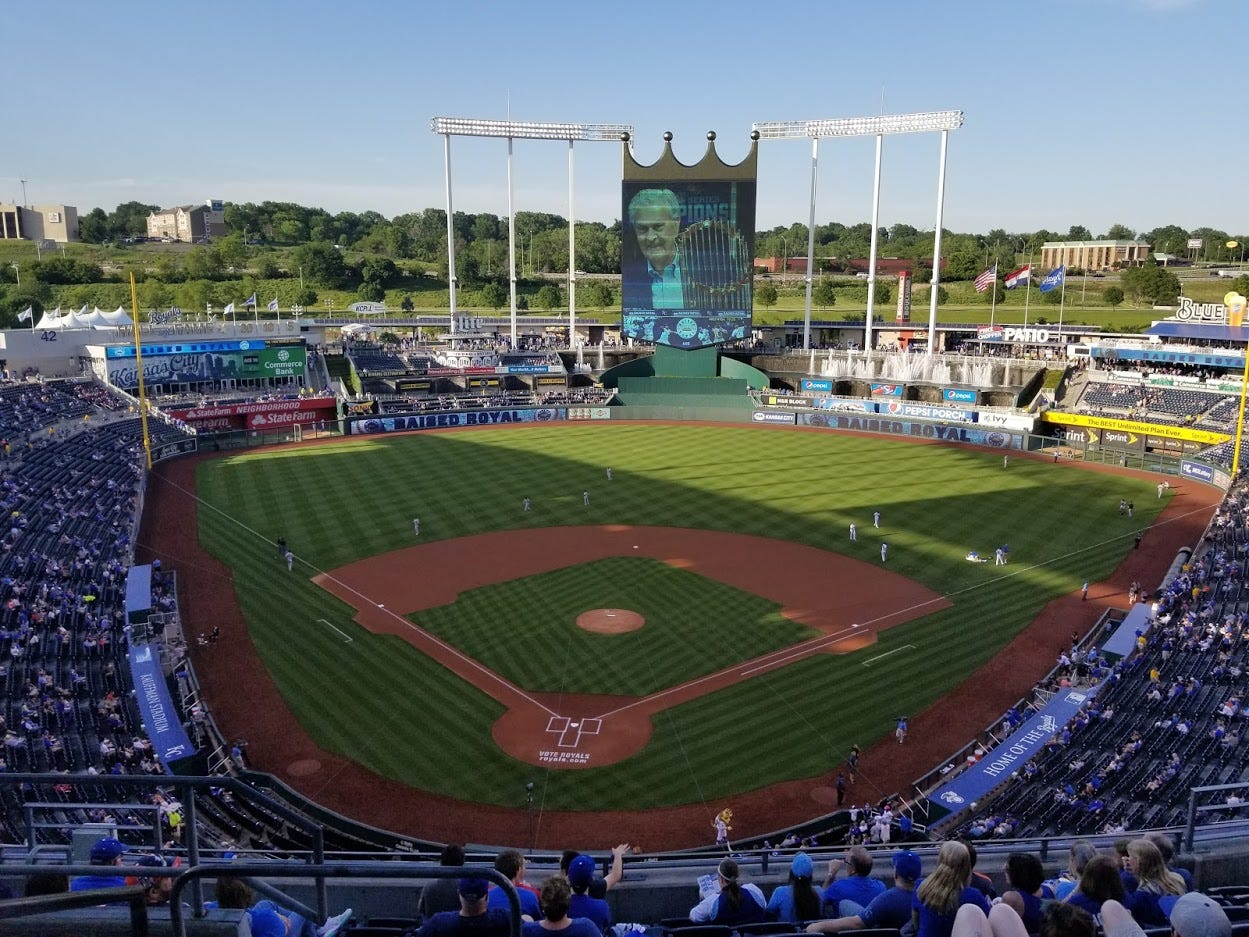
The Kansas City Royals announced a change is projected to be worth an additional 1.5 wins next season: the club is moving the outfield walls in left and right field and lowering the fence by 18 inches in most places. The Royals are specifically altering the layout of the field to favor their offense at home. Kauffman Stadium is unfriendly to hitters, and the dimensions of the outfield have turned homeruns into caught balls. In the past, the Royals have attempted to build the team to suit the unique home field, signing contact hitters and favoring speed for the second-largest outfield in the sport. With the change, the small-market Royals no longer need to have such rigid personnel targets.
Sportico is a favorite of mine, the business and stats of sports is a fascinating topic these days and I regularly find great stories from that crew. Given that we’re in the midst of a sports hotspot right now, from the Super Bowl to the Olympics and soon on to March Madness, I wanted to chat with Eben.
We spoke about the baseball team moving the walls of its stadium for advantage, the latest innovations in jersey advertisements, why the incentives have shifted for players to stay in college and what obscure sport’s time has come.
Eben can be found at Sportico, at their fun newsletter Club Sportico, and on the Sporticast.
This interview has been condensed and edited.
Hey, Eben, thanks so much for coming back on.
Thanks for having me, Walt. It is always a pleasure.
I’m such a fan of what you guys do at Sportico and also your newsletter Club Sportico. It feels like sports have really dominated the calendar lately, and I wanted to have you back on. How’s it been for you guys?
I think it’s been good. You’re right. The Super Bowl into the Winter Olympics combination definitely makes it really part of this year in specific. Mike Tirico’s probably listening to this laughing, rolling his eyes, because he had the real challenge. Definitely, the Super Bowl is a two or three-week thing for us, really, and the Olympics is also a two or three-week thing. I’m hoping that before March Madness, there are a couple of slow days before we rev back up again.
The Super Bowl is also, for what it’s worth, a very considerable business event, right? You guys are the business of sports, and there’s a corporate atmosphere at some of these events.
Yeah, that’s exactly right. I go to the Super Bowl city every year. I never go to the game anymore. I’m usually flying out of San Francisco on Saturday morning this year, which is great. But, yeah, it’s really great. It’s productive. There’s a lot of networking. I often feel like I’m going to some city to go to parties that have the same people who also live in New York in them. And I’m like, “Why don’t I see you during the year when it’s easy? And then I don’t have to fly across the country to do it?”
Sports are not a huge industry. But even if you don’t work in the NFL, even if you don’t work in football, a whole concentration of folks who work in sports are at the Super Bowl. There are really very few other events like that on the calendar. It is basically a must-go-to for folks in our industry.
Yeah, it’s always fun to see the stuff that comes out of it. But there were a few reasons I wanted to have you on. Again, I think that Sportico is just so fun, and Club Sportico is really great.
You had a story a few weeks ago that genuinely delighted me. It was called “Moneywall” and you were talking about how sports optimization has hit a whole new level where they’re literally changing some of the key elements of a stadium’s construction in order to facilitate wins. Do you want to talk a little bit about that?
Yeah, for sure. I thought this was one of those moments where you read something and your brain just starts spinning immediately. So the Kansas City Royals announced earlier this year that they were changing the dimensions of their stadium. They’re bringing in the walls in right field and in left field, and they’re lowering, by 18 inches in many places, the fences. Changing the dimensions of a stadium is not something that typically would interest me, but I’m always looking at things through the business lens. My original thought was, “Oh, if you’re moving fences in, you can put in a few more rows of seats. There’s probably a premium hospitality play here that’s going to make more money for the Royals.”
I started reading about it, and the first quote I read was from general manager J.J. Piccolo. He’s talking about how they looked at the Royals’ roster and their hitters and their pitchers and the fly ball rate of their pitchers and the sluggers that they have. They felt like this dimension was going to impact their hitters positively, but not negatively impact their pitchers in the same way that it would impact their opponents’ pitchers. Immediately, I was fascinated by that, right? As you said, baseball has more than any other sport been maximized for every single layer of advantage, of statistics, of expertise, particularly clubs like the Royals, who don’t have money that the Yankees and the Dodgers have. They’re always looking for where we can squeeze this little minimum amount of advantage out of what we have.
Stadium construction is not one that had been on my bingo card of places where you can find value. But the Royals looked at this, and they determined two extra wins in a given year with these dimensions versus the other ones, given the current construction of their roster. Two extra wins is huge. Teams make way bigger decisions based on win probabilities that are way smaller than that.
So yeah, I was immediately fascinated by it, and then dug into the history of all this: what the rules are for Major League Baseball. I was expecting there to be a rule that says you can’t make this change constantly, and that rule doesn’t really exist. It made me think that maybe the Royals are hitting on what may be the next frontier in baseball optimization.
Yeah, it was an amazing piece. It’s the question of, if you can’t compete with the most expensive teams and the most expensive players in the sport, how do you eke out edges here and there? I always remember a friend of mine, Tyler Lauletta, telling me about when Mark Cuban bought a basketball team. He was like, “What can I do to make your lives easier?” And adding a daycare facility is a fraction of the cost of a star player, but if it can make your people just a little bit better, it can do it. It seems like baseball is very honed in on just scraping any possible advantage they can get out of that.
Yeah, and on our podcast recently, we had the president of the Dodgers. He was talking about the success they’ve had wooing Japanese free agents. Not just Shohei Ohtani, but Yamamoto and Roki Sasaki. It goes down to the toilets in their clubhouse and having Japanese bidets that players want to see. There’s a great story he tells about Shohei walking through their batting practice facility, and there was one cage underneath the stadium. Shohei was like, “I think if you had two cages, that would be better.” And he was like, “Great, we have two cages, consider it two. By the time you get here, we’ll have two.”
So yeah, you’re right. There are so many little things that go into getting better players, signing players to better deals — keeping them healthy, which Mark Cuban did a lot about. Mark Cuban once told me that the only people he wants to lock up longer than his players are his doctors. There’s so much innovation happening in terms of making your teams better. If stadium construction is one of these things that’s relatively untapped currently, and if there is an advantage that other teams see here, I wouldn’t be shocked if we see a lot more of this in the future.
That’s really cool. Yeah, again, I think that a lot of the moneyball element of sports is often “where can you get that little extra stuff?” You actually just had a story this week about Major League Soccer expanding the number of advertisements on their jerseys. It felt like another instance of that, where they realized there’s actually space on the lower back that we can start selling for a million a year. They’re not going to leave that money on the table.
This is a classic challenge for a lot of sports. At what point do your commercial endeavors too much for fans? There’s a reason why commercial breaks are two and a half minutes long and not eight minutes long, because fans would revolt. There has historically been a reason why there has not been that many ads on uniforms in American sports. They like the clean look. And American sports fans like a clean look.
I don’t know if you’ve ever looked at hockey players in Europe. The Swiss League or whatever. Their jerseys look like NASCAR cars. That’s everywhere. That’s culturally accepted in those leagues. It’s a little different here in the U.S. MLS, more so than any other league, has been testing the boundaries of “How far can we go here.” Clearly, they believe that the front of your jersey sponsor, the two sleeves and now the lower back, is a totally acceptable amount of ad space that doesn’t bother fans. MLS has an interesting advantage here in that ads on jerseys are way more common in global soccer.
Sure.
But when I talk to executives of the league about this, one of the things they keep saying is that this is in keeping with the global sport. It’s not like they’re doing something radically different than what’s happening in the Mexican soccer league or what’s happening in the Spanish soccer league, etc. But we’re now at the point where the NFL is the only major U.S. league that doesn’t have ads on player uniforms during regular season games. I wouldn’t be shocked if that changes at some point. College football is going to have these ads coming up soon. Basketball has the sleeve. Hockey has the sleeve and the helmet. Everybody squeezes every last dollar out of their endeavors. I think you’re going to see more ads on uniforms, helmets and shorts moving forward.
You mentioned the college sports, which is interesting, too, because they’ve obviously had such a big shift lately. I know your colleague, Michael McCann, has written a lot about the growing tensions between the NCAA and the players: specifically, players who want to be able to squeak out more and more years of eligibility. College was a place where you could get a reasonable degree of local fame or maybe get a shot at the NFL, then quit after five years. It has become a place where you can make a lot more money as a mediocre player playing college for seven years than you could in the NFL.
It’s a fascinating dynamic that’s happening here now with the way that athletes are being compensated in college and the way that professional leagues here have traditionally tamped down rookie pay scales. The dynamic you just said is a central question for the NFL, which has basically no business threats at this point. People always ask me, “Ifyou were in the NFL, what would keep you up at night?” Nothing, basically, business-wise. The sport is so popular. It is such a unique cultural place in America. They print money, literally. Sports teams print money. NFL teams print money.
But the changes in college football would scare me a little bit if I were an NFL owner. For decades, the paycheck for being a late first-round draft pick or second-round draft pick was so amazing for college players who were getting very little, maybe getting some cash in a bag, but getting very little. And now, outside of the first couple picks, a lot of players are going to be taking pay cuts to join the league. That changes the dynamic a lot. It’s one of the reasons we’re seeing players, particularly high-profile quarterbacks like the one at Vanderbilt (who maybe doesn’t have a huge NFL career waiting for him but can make a lot of money in college), why they’re pushing the boundaries of eligibility in college. The WNBA has faced this for a few years now, where players even at the highest range were taking pay cuts, Caitlin Clark included — taking pay cuts to go from college to the pros.
It definitely creates a different dynamic. With the labor rules of an entry draft, which in any other profession would seem so insane, you don’t get to choose where you go to work. No, no, no, that’s going to get chosen for you, totally out of your control. And then whoever decides they want to hire you, they’re going to be not only your employer now, but they’re going to be your employer for the next four to five years. It’s such a crazy concept in any other setting. And again, it hasn’t been challenged that much because the money was so good. But once you take the money out of that equation, you’re going to see star college basketball and football players who are looking at the NFL draft and the rules around it and say “That doesn’t seem fair at all, and I’m not sure I want to participate in that.”
That is really interesting. I had not thought about the potential risk for the NFL in that regard.
We saw it a little bit with Caleb Williams. When he was drafted first overall by the Bears, coming out of USC. He was making a lot of money, obviously, as the star quarterback at USC in the new NIL market. From what I understand, and this has been written about before, he and his family were considering various possibilities in terms of him maybe trying to play somewhere else professionally for a year or two to get him out of the draft class, to try to get him to enter the NFL as a free agent style thing. 10 years ago, Caleb would have happily entered the draft. This time in 2023, he entered the draft side-eyed, looking like, “This seems weird. Why do I have to do this? And why can’t I get more money from teams competing to try to get me?” I think that’s an interesting one for NFL teams, for sure.
It reminds me of the multi-sport athlete thing from a few years ago. Like, if you are a good baseball player and a good football player, you would want to go pro in baseball because the money’s way better. When there’s an opportunity of choice, obviously the NFL is going to look like a somewhat shabbier experience for a labor guy, right? Now it’s just that, but it’s your own sport competing with your own sport.
Exactly, exactly. And you have options now that you didn’t have before. If you asked me 10 years from now, what does the NFL draft look like, I genuinely don’t know the answer to that question. But I don’t think it would look like the way it looks right now. I think there are changes that happen at some point. I think the change comes from this dynamic we’re talking about, where the value proposition for college athletes entering it becomes very different when the good ones are making $10 or $20 million.
Soccer’s always been five years away from being popular in America for the past 50 years. But if soccer gets more attractive for players who would have been wide receivers or running backs, you can really see these dynamics start changing.
There’s a stat that I always like to share about this because I think it’s fascinating. Another dynamic in the rookie pay scale stuff is that because there are no rookies in the NFL Players Association, they are consistently turning down the pay that gets put to rookies. There’s no one in the union that’s representing rookies, right? Everyone in the union is like, “Oh, take it away from the rookies. I’m not a rookie. It doesn’t affect me.” When Sam Bradford was drafted — he remains the highest-paid number one draft pick ever in NFL history. And he was drafted 15 years ago. But he was drafted as the last class before the new collective bargaining agreement took place.
The new CBA dramatically lowered the NFL rookie wage scale. The gradual increases in the rookie wage scale have not yet caught up to the rookie contract that Sam Bradford signed back in 2010 when he was picked first overall. Everything goes up in the NFL in terms of salary and pay and money. But in this one instance, the rookie pay scale right now is basically roughly around what it was in 2010.
That’s really interesting. That’s a fascinating point. I want to finish on a thing that I get from Sportico more than I get from anywhere else, which is the guy trying to invent the Super Bowl of his sport.
You have written about a guy who is trying to make the Bassmaster Elite Series and the Major League Fishing’s Bass Pro Tour, turning those into the have one thing that decides the sport. This has obviously been an interesting year for curling; they’re trying to get that popular. Your colleague Louisa had a story about the Major League Table Tennis trying to get a big funding round because they’re trying to ride the back of Marty Supreme. What obscure sport has your attention right now? Because this is always a delightful thing that I really only get from Sportico.
It feels like we’re in this heyday of startup sports leagues. I think there are a few reasons for it. There’s a lot of froth in professional sports right now. Valuations for the big leagues continue to go up, but there are only so many of those investments. People are like, “I would love to own a sports team, but I can’t buy an NFL or NBA team.” Now there’s a bunch of lower-down sports at much lower price points that people can get into.
I think the changes in media have also made this a little bit easier. Before, if you couldn’t get one of the handful of TV networks or broadcast distributors to host your games, what was the point of doing it? But now you can produce your own games, and you can put them on YouTube for free. There’s a whole bunch of options. There are streaming companies that are looking for content. There are a lot more options to distribute your games, and as a result, the value prop for starting these leagues gets better.
There are a few leagues that I’m fascinated by. One of them is TGL, the mid-week AR VR golf league that Tiger Woods and Rory McIlroy backed. I think that model is probably the future of sports in some way. This blending of real life and also getting into a screen or AR and VR, finding the proper balance of those two things. I don’t know if they timed it too quickly. I don’t know if they were 10 years too early or 20 years too early. I’m not sure, but I feel confident that at some point, some generation of young sports fans is going to be watching a lot of sports that look like TGL in some capacity.
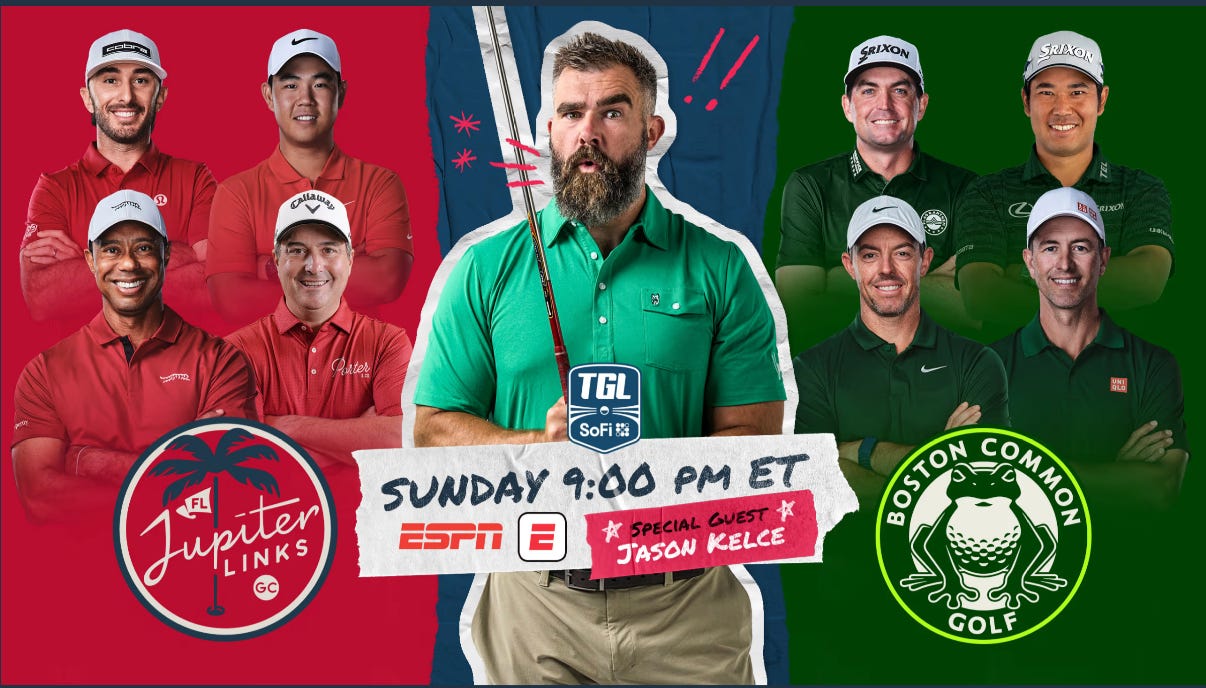
That one is really interesting, and they’ve expanded. They just launched a women’s league. From what I understand about valuations, they’ve gone up quite a bit recently. The list of investors is very impressive, and there are a lot of names that you see across the industry in other ways. So they’re really interesting.
I think the PLL, the Premier Lacrosse League, launched by Paul Rabil, is fascinating. They’re maybe the OG of this new wave of new age sports. I mean, Paul was the Michael Jordan of lacrosse. In his prime, he left the sport, started his own professional league, and then bought the league. It’s basically like Michael Jordan in 1988: leaving the NBA, starting a professional basketball league, and then buying the NBA two years later. That’s basically what he did. And he has some really interesting vision about the way in which players can be mic’d up during games and the way in which games are packaged and sold and distributed and broadcast in a way that’s really interesting. So I find them to be a really fascinating one.
I’ll give you one more because I think it’s also interesting. The Kings League, I don’t know if you’re familiar with them, but it’s a startup soccer league. Mostly in Europe, but they are working very hard on celebrities and influencers.
Are they usually on YouTube? I feel like I read about them in Garbage Day.
Yeah, that’s probably right. I think the thing that they have done, which I also think is probably the future, is the blending of whether people want to watch professional athletes, the best in the world, or do they want to watch this famous influencer pretend to be a famous athlete? I think Jake Paul is an interesting clash of this. There’s a world I can see where a lot of sports lean more not into the people who are literally the best in the world at it, but the people who are the best entertainers at doing it.
The Kings League, which is a seven-on-seven format, has blended really high-level soccer with internet celebrities, for lack of a better word. And that, I think, is also a really interesting concept that we’ve seen a bit of. It’s hard to make it work. But theway that young people are consuming media nowadays and entertainment, sadly, it does make me think that there may be a future where you don’t have to be the best in the world at doing this thing to be the one people want to watch. You just have to make it compelling and fun.
The WWE-ification of a lot of this stuff is super interesting.
Yeah.
If people want to read more about that, where should they find you?
You can find the more fun stuff that I do is on the Club Sportico, which is our substack, which is club.sportico.com.


The more serious stuff that I’m writing is on sportico.com. That’s me and a bunch of my colleagues. Lastly, there’s a podcast that our editor-in-chief, Scott Soshnick, and I post twice a week. It’s the Sportacast, and you can find that one basically anywhere you get your podcasts.
Awesome. Well, hey, thanks for coming on, man.
This is great. Thanks, Walt.