
By Walt Hickey
Welcome to the Numlock Sunday edition.
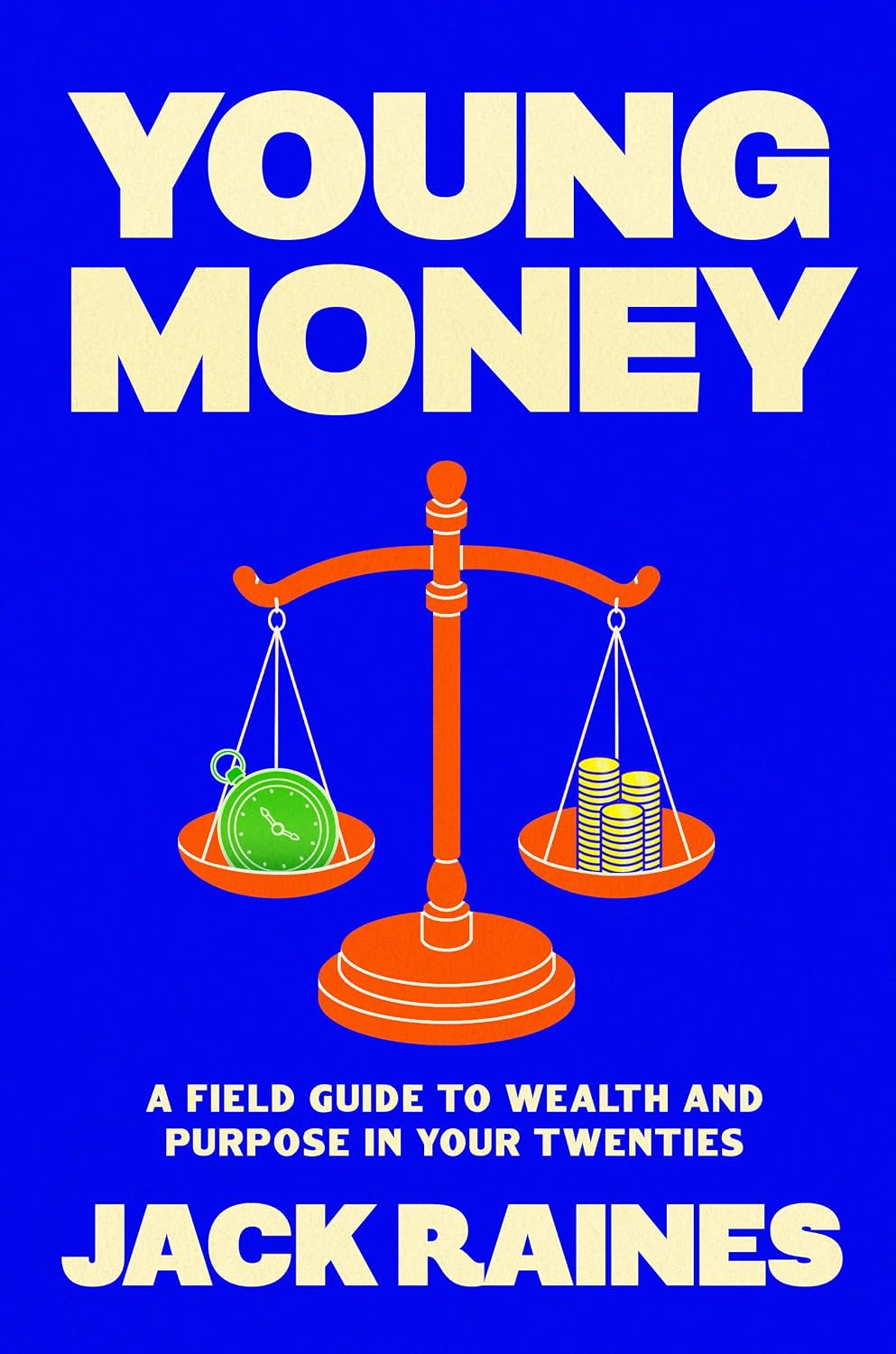
This week, I spoke to Jack Raines, author of the book Young Money: A Field Guide to Wealth and Purpose in Your Twenties which is in stores this week. Jack and I worked together at Sherwood News where he was responsible for some of my favorite stories, he has had a longrunning newsletter about money and has always had some fascinating ideas.
The book is available wherever books are sold, and he recorded an audiobook available wherever you get your audiobooks.
This interview has been condensed and edited.
Jack Raines, it is so good to talk to you. A former colleague of mine at Sherwood and the author of the brand new book Young Money: A Field Guide to Wealth and Purpose in Your Twenties. Thanks for coming on, man.
Walt, thanks for having me.
I’ve known this book was in process for a long time. I have been so delighted to actually get it in my hands. You are just such a gifted and talented writer. You’re very incisive. I think that you have a way of seeing the world — whether it’s how business works, industry works or even personal finance works — that I think is just revelatory.
Just taking a step back before we get into the nuts and bolts of the book, what got you interested in money? And how do you see money as potentially differently than other folks do?
Before I get started, the whole meta angle of, “You should be my boss and I sign this book deal while working for you.” There’s like seven levels to this. It makes it a lot more fun.
I mean, on the money stuff, it’s funny. I had never really looked at money in a vacuum. I think a lot of people think about careers as “How much money am I earning at this age?” Or “Do I get equity and companies by this?” Or it’s always “How much money do I think I’ll be making? And what do I set my net worth to be by different points?”
It’s not that I’ve never tracked that stuff or don’t care about it, but I’ve always viewed money as how much utility or life enjoyment I can get from my dollars at different points in life. And how much do I think I’m going to want to be able to get from different points in life? So this whole book, Young Money, I wouldn’t even really call it a personal finance book as much as a book on opportunity costs.
Money and time are the two inputs that really go into that. You have a finite amount of money and finite years in your life. Within that, you have finite years within each specific period of your life: early 20s, late 20s, 30s, 40s, so on. You have years where you don’t have kids. You have years where you do have kids. At each of those points, you’re going to want to optimize for different stuff, and it’s going to cost different amounts of money to do that.
Throughout the book, a big thing that I’m focusing on is thinking through how do you maximize how much satisfaction you get from each life stage and how much money does it take to do that? And that number is a lot less in your 20s. The dollars needed per unit of fun at 24 is just way different than it is at 44, right? So the biggest thing I try to reframe is not just thinking about money as a number, as much as where you are in a particular stage of life; how much you actually need to get what you want.
Yeah, I think that’s what I’ve always really enjoyed about your work. You have a reputation as a guy who writes a lot about money, but I think that realistically, the dominant theme of your literary work is ultimately utility, right? And how you actually execute on that.
Yeah, yeah. I joke that I write about the human experience as I see it, but money happens to be a necessary but not sufficient input for that.
That’s fun. Let’s talk about some of the ideas that you get out of the book. I think one of the more compelling chapters that actually really gets at what we’re talking about here is the case for living life backward. Do you want to talk a little bit about that and how that can affect people’s perception of their own current situation as well as where they actually want to go?
Yeah, I mean, I was a pretty angsty 24-year-old. I also think it’s a byproduct of being a Covid college graduate, where I basically spent the first year and a half out of school working remotely, which sucks. But I was sitting there. I knew I was going to start grad school in a year or a year and a half. I didn’t really know what I wanted to do with my 20s, slash with my life. And I had all of these half-baked ideas and plans and paths.
I ended up talking to this guy, Dr. Jim Jackson. He used to be the pastor at my grandparent’s church, and he was the pastor at a megachurch in Houston. Now, he has a couple of businesses, executive leadership coach. He’s worn a few different hats. We ended up chatting, and he was the one who first laid out this idea of living life backwards. But basically, his take was that you have to set constraints on your life to figure out what you want to do with your life. Because as long as you’re in this headspace of there are a bunch of hypothetical things I would like to do, it becomes really, really difficult to stack rank and then go execute on them.
But when you really work backwards from, all right, say I live to 85 or 90, and then I’m going to die. What are the things I actually want to do with my life or want to have experienced in my life before I reach that point? And then you can actually start, saying “Okay you can’t do it all. So what are the things that actually matter?” As you work backwards from grave, not to be morbid, to the present day, what’s the order of operations in which you need to do those things to either make them possible or to maximize enjoyment from them?
For me, it’s something that I really wanted to do. I was a big travel junkie as a kid. I really romanticized this idea of backpacking the world. I just thought that was the coolest thing any person in their 20s could do. It was a thing that I was “Oh, maybe I’ll travel for a month or two before grad school or maybe after business school or whatever.” Of all the things I wanted to do, the most stressful one was wanting to go see as much of the world as possible and do it in a cheap, fun, thrill-seeking way. And that conversation has made it very, very clear that a lot of this other stuff I had time to figure out — career stuff, family stuff, where I’m going to live when I’m older.
But the big adventure I wanted to go on had an expiration date that was probably in a year to a year and a half. By thinking through life backwards and thinking through what are the more holistic, long-term things I want and what are the actionable things I should go after now, it frankly gave me the confidence to just take a leap. A few months later, I quit job number one and I bought a one-way ticket to Barcelona. On the outside looking at it, it seemed impulsive, but it was actually pretty structured and planned.
Yeah, I really think that it’s just very thoughtful. A lot of the book talks about both this idea that’s very common in discussions about money, which is compounding, but also expanding that outward to other elements of life.
Yeah. I have a chapter called “Memories Calm Down Faster Than Money.” Money is a very easy thing to conceptualize and turn into a scoreboard because it’s like a physical asset and a number. You know how much money you’re making and how much your net worth is at any given point. But it’s like there’s tradeoffs to everything. And if you hyper-optimize for money at certain stages in your life, then there’s other things that could compound — like relationships, memories, there’s certain things you might spend money on when you’re 24, 25, 26, that a financial advisor might say you should contribute more to your 401k because that extra $5,000 a year will compound and be worth $100,000 in retirement.
That’s fine, but the flip side is when you’re at retirement age, do you think you would spend $100,000 to get back the experience that you could have spent $5,000 on when you were young? If the answer is yes, then maybe you should have spent that money earlier, right? It’s easy to see how money compounds because you can open Excel, put in 8 percent return, 40 years, $10,000 and enter, and you can see how much money that you would have if the market keeps growing.
But it’s much harder to conceptualize, “How much fulfillment will I get from the memories created now that you can experience through nostalgia?” Or a time spent with friends when you’re only going to live in New York City with your best friends for so many years before people move off and get married. I’m, maybe a bit to a fault, much more on the cap of it’s okay to overspend a little bit in your first five to 10 years of adulthood if it means making memories that you’ll cherish for the next 30 to 40 years.
That’s kind of funny. Viewing the inevitability of nostalgia as a fundamentally compounding element.
Yeah, it’s funny. Bill Perkins, he’s a really good writer, successful, out of people who’ve won life, I would put him up there. And then he is very rich and ran an energy fund. I think he’s produced a movie. He’s a pro poker player. He’s also a really good writer. And he wrote a book called Die With Zero, where he coined the term “memory dividends,” which I love. And it’s basically this idea that, every time you get to experience a memory that you enjoyed, that’s a form of payment or dividend, just like you get dividends from stocks. You should be trying to optimize for creating as many of these memory dividends as possible.
I dig that a lot. I want to talk about another pretty pervasive theme in the book. You spend a lot of the back half talking about status. Status and money can feel very interchangeable, but also are very fundamentally different things. People can attain status without money. People can attain money without status. The difference between those two things is a source of a fairly considerable amount of consternation and anxiety across lots of different social groups in America, I would say.
Obviously, when you write a book, you spend years working on this sucker. But these chapters feel very, in particular, suited for a lot of the moment right now and feels rather relevant in terms of the difference between social status and money, and where that can bite and where that might not.
My take in general is that most people want money, but I actually think the desire for status to both be respected and revered by your peers, and candidly to feel like you are better than other people. And I don’t even mean that in a conceited way. Humans are inherently status monkeys. Everybody is comparing themselves against other people in some way. Status happens within domains. Writers compare themselves to writers. Investors compare themselves to investors. Athletes compare themselves to athletes.
It’s a thing from the time that you’re in middle school playing basketball or trying to figure out which girl to ask to the homecoming dance up until you’re a 40-year-old hedge fund manager. Status games, I think, are an entirely pervasive thing that we can’t fully escape. The interesting comparison of money to status is that a lot of things that give you status give you money. And I would argue that anybody who achieves high net worth through their own work, probably gains status with that.
The money on its own does not equate status. Example being if you win the lottery and you get $100 million, nobody’s gonna consider you high status. You got lucky, right? Versus if you build a company and sell it for $100 million, it’s a different game. If you’re born into a high net worth family, and you start off with $100 million, your last name is high status. But that doesn’t necessarily mean that people will respect you until you do something to live up to that.
This desire for status is as pervasive as the desire for food or water or oxygen, and that everybody wants acceptance from other people. And I think it leads to a lot of people making career choices that oftentimes are lucrative and well-paying, but are really a path towards status approval.
People make certain job choices out of undergrad. You go to a competitive school, you think there’s only like two or three jobs you can do. You go be a consultant, you go be a banker or you make plans to go to law school. And that’s because historically, those are the jobs that are paid well, but also there’s this higher social cache, a level of approval. You work at Goldman, that validates you, right?
The issue is, you get there, and then there’s another status level. The easy route for me to pick on, having gone to a business school, it’s the people who go into investment banking, private equity, business school, and then that’s private equity or hedge funders trying to climb the finance ladder. That ladder gets more and more narrow at the top, and there’s also just always another level to it. The issue of chasing status is that, one, there’s actually never an endgame. There’s just never a point where you have “top status,” there’s just always another level of thing that you can strive to achieve. The irony of status is that the people who actually have the most status probably weren’t chasing it to begin with.
I have a buddy, he’s been a bond trader for eight, nine years now since college. Really good at it, makes a lot of money. He just interned at a bank in college and just loved the game of figuring out which numbers were gonna go up and down and playing it. It has never felt like a job to him. It’s like an arcade, right? And he makes good money now. He’s probably one of my wealthiest late 20s friends. But there’s other people who go into that job because they see finance as a status thing and trading as one of many status games you can play within that.
The difference between those two people is that the former, my buddy Tucker, he actually loves what he’s doing, and that makes him more inclined to spend extra time on it and work harder on it and make more money doing it. The person who takes the same job because they feel like it’s what they’re supposed to do, might initially make a high income, but they’re just gonna flame out. They’re not gonna win. If you’re pursuing status in the same field that somebody else is just doing a thing that they like, you’re just gonna get your ass kicked.
So my take on all this, it’s not that optimizing for money is a bad thing. I think all things equal, more money is better. But if you’re just chasing status for status sake, you’re inevitably gonna hit some point where somebody who wasn’t chasing status is in the same domain as you, and they’re gonna kick your ass. And then you’ve made this thing that you’re doing such a core part of your identity, that when you lose it to someone else, I think it leads to a lot of soul searching.
So my whole take on status is that I don’t think we can totally avoid it. I think it’s always a thing that’ll exist. But if you’re gonna play a status game, you at least want to be in a field where you have independent interests and desire to do well in that thing.
A lot of times you see people’s attempt at a second act in their career being the thing that they actually truly want to do. I think a fun thing about your book is that it’s just saying “You should just have that be the first one.”
Right, right. I mean, there’s nuance to this, right? This is actually very ironic. I was working for you for a year, but a big part of the reason I wanted to make my career pivot was I realized I love writing, but I didn’t necessarily want to be in media. I like writing books and blog posts. I realized I didn’t want to be a traditional journalist. And it’s okay. So I went after the more passion-y career path for a bit, and then moved into the investing world, because it’s another thing that I’m independently interested in.
But there’s also a lot of long tail offshoots where if you play out 100 scenarios, they might be more lucrative than if I stay in the media path, right? There’s people who have gone the headstrong route, made a lot of money, and then they decide, “Okay, I now want to be a writer.”
I’ve been reading 1873: The Rothschilds, the First Great Depression, and the Making of the Modern World. I don’t know if you’ve read it yet. I’m a bit of a history dork. It’s about how the Rothschild banking industry got built out and all these financial bubbles in Europe. Really fascinating. The guy who wrote it was like a long-time worker for the World Bank, was in asset management in London, presumably made a lot of money in finance. But then he left to write and he won a Pulitzer for one of his books.
Phenomenal writer. I actually don’t think he would change the order of operations and just write. I think by having the financial stability that he gave himself, he could focus solely on the writing without having to worry about the book advance or a number of copies sold or whatever. Going back to the living life backwards framing, he probably implicitly had some version of, “I’m going to make a lot of money and I also want to write, but I can write over the course of my entire life and I have career traction to compound more money now.”
It’s not like what he did was right or wrong, but I actually don’t think he would change the order and just be a writer the whole time. By front loading money in his career early, he gave himself a lot more leeway to spend time working on the written word without having to worry about the economic outcomes. So my take away on all of it is that the most important thing is not any particular choice or order of operations, but just being really self-aware and having a strong level of intentionality with whichever path you choose.
Now that you’ve sold me on that other guy’s book. Why don’t we sell people on your book.
Why don’t you tell people a little about the book, where can people find it and where can they find you?
Yea, 100 percent. So the book, again, is called Young Money by Jack Raines, subtitled A Field Guide to Wealth and Purpose in Your Twenties. You can find it on Amazon, Barnes & Noble, Booksmillion.
The audio book will be on Apple Podcasts, Spotify, wherever you listen to books. I recorded a whole audio book in two days. That was a lot of fun. I spent like 11 hours a day, two days in a row and we were done. It was great.
I heard it can be a gigantic pain to do those.
I was going to say, did you do an audio book for yours?
No, I left that one to the professionals.
Yeah, no, I enjoyed it.
But anyway, yes, you can download it anywhere. As far as where to find me, you can look up Jack Raines on basically any social media platform.I have a cowboy hat in my profile picture. It was from my headshot — first day of Sherwood News two years ago, three years ago, whatever it was. Anyway, yeah, look for the Jack Raines cowboy hat picture. Yeah, buy your copy of Young Money. Comes out two days after this gets published, August 4. Preorder, buy your copy. Hope you enjoy it.
Awesome, thanks for coming on Jack.
Dude, thanks for having me.

Edited by Crystal Wang
If you have anything you’d like to see in this Sunday special, shoot me an email. Comment below! Thanks for reading, and thanks so much for supporting Numlock.