
By Walt Hickey
Welcome to the Numlock Sunday edition.
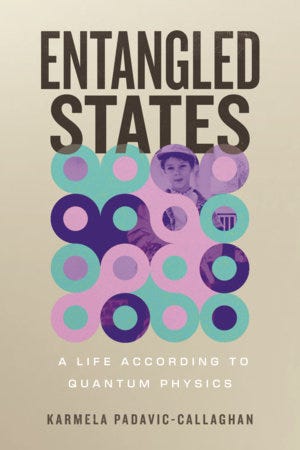
This week, I spoke with Karmela Padavic-Callaghan a physicist and journalist who is out with a new book, Entangled States: Life According to Quantum Physics.
It’s a great read about the frontiers of physics, part memoir and part dive into the fascinating idiosyncrasies of particle physics.
Entangled States is available wherever books are sold. You can find them at New Scientist or their personal substack Ultracold.
This interview has been condensed and edited.
Karmela, thank you so much for coming on. You are the author of the brand new book, Entangled States: Life According to Quantum Physics. To start off, you are a science writer, you work for New Scientist. Do you want to talk a little bit about your work in general, your beat and what got you interested in physics?
Yeah, thank you. I am a full-time staff writer at New Scientist. My official job is physics reporter, but within physics, which is a huge category, I like to say I focus on things that are smaller than space. So you will not find me writing about galaxies or stars, but you will find me writing about atoms, materials and increasingly quantum technology like quantum computers and quantum networks.
I have a background in physics. I have a Ph.D. in theoretical physics. I had wanted to be a physicist since I was 12 years old. In between working as a physicist and now working as a physics writer, I was also a physics teacher, so I really had my fingers in every pot within the physics world over the years. It’s always been a huge point of curiosity for me, and being a physics reporter is actually the best way to satiate that curiosity because I am on the phone with two or three physicists every day, and I’m learning remarkable things that I hope I can then bring to the general public.
This is just such an interesting and fascinating beat, particularly now, because there are some of these very high-profile experiments going on. It’s a field where you’re seeing consistent and interesting breakthroughs, and it’s just been very rewarding for folks, I think, who may not necessarily have a background in physics to start following the field. And I’ve enjoyed your work in particular and New Scientist as well.
I think we’re in this really interesting inflection point where for a couple years there were like two or three huge mega-experiments like particle colliders in Europe and so on. Every year, you were waiting for the next data drop and you were going to discover something big. But the field’s diversified so much now that people are doing remarkable things with tabletop experiments in labs, and even private companies are building some of this new technology in more classic R& D settings. If you want to be plugged into the frontier, there’s always something happening. The frontier is constantly moving, and that’s part of Entangled States also. I am writing from the perspective of someone who has been plugged in and where the cutting edge is today, tomorrow, and the day after.
Yeah, I want to get to the book in just a moment, but you said something really interesting there, which is like, there are a lot of interesting advances happening outside of these 30-mile-long atom smashers. Even just this past week, we saw news with regards to several quantum companies getting federal investment that a lot of this seems like this is moving somewhat out of the theoretical and into the rather realistic.
Yeah, I mean, so the $2 billion announcement is particularly interesting. The government is taking equity stakes in nine different companies, which I think is a real recognition for the quantum computing industry as something that’s not futuristic anymore, but rather is happening at this time right now.
Jay Gambetta at IBM fed me this line a couple years ago, said quantum computers are not science fiction anymore, they’re now science fact. Of course, if you’re trying to sell people a quantum computer, you would say that. But I think it’s increasingly becoming very much true that these are not lab experiments as much as they used to be. They are things you can buy on a chip from a private company. And the governmental investment is an interesting point. I think some of it is driven by competition with Europe and China.
But some of it is also the recognition that in the last maybe three years, the private part of the industry, some in collaboration with universities but very often you see university labs spin off into startups to then partner up with other startups, that part of the industry has really grown extremely quickly. I used to only talk to professors and now I’m talking to startup founders all the time. And the government getting in on the game, I think signals that they also think that it’s real.
Since we’re talking about the government, I should also mention that DARPA, the military research arm, has this huge initiative to come up with the best strategy to build a functional quantum computer. They have the biggest team of evaluators that anyone’s ever put together. And all these companies are like letting them look at stuff that’s on their IP that no one else has looked at.
I think multiple branches of the government are really taking this extremely seriously. If your readers have seen headlines about Q-Day and cryptography problems, all of this is really coming to a head. It’s such bad practice for a journalist to predict the future, so I’m not going to do that. But I think in the next two or three years, we will only see the technology accelerate.
This is an excellent transition to talk about your book, Entangled States. This is such an interesting approach to talking about a topic that I think can oftentimes feel fairly alien to people, can feel very impersonal. Quantum physics is obviously a bit of a stretch even for folks who maybe had a good time in more conventional physics, right? Do you want to talk a little bit about the book, your approach to it and how you integrate a little bit of memoir into it?
Yeah, exactly. So the book is a hybrid memoir in the sense that it doesn’t follow my life beat for beat, but it’s split into thematic sections and each chapter has a physics concept that anchors it. To get around what the physics concept is and why it’s worth thinking about even if you’re never going to be a physicist who works in the lab is that I tell some anecdote from my life that has some resonance with that physics concept. So I am trying to take these very abstract things that may just exist in the language of mathematics, textbooks or you see them in a class and you’re like, “What is this?” I’m trying to take that “what is this feeling” and give it grounding in something that may feel a lot more personal.
So it’s obscenely personal for a physics book and obscenely mathematical for a memoir, but putting them together I hope gives people an entry point into something they may otherwise consider, as you just said, intimidating. Physics gets a bad rap. I used to be a high school teacher. I taught physics in ninth grade and kids would come to me on first day of class and be like, “I think I’m going to suck at physics” and I’m like, “You’ve never taken it before. How do you even know?”
But this reputation precedes it and I’m trying to get ahead of that by saying, “Look, I’m not an Einstein type. I’m not revolutionary. I’m just like some guy who went to physics classes a lot and got a degree and it changed my life.” And here’s how I want to tell you what it did for me, how it changed my brain and also why it may be worth engaging, in this more personal way.
Let’s dive a little bit into that again, you talk a little bit about how understanding quantum has helped you understand other topics as well in other areas of your life. Do you want to talk a little bit about maybe some of those and ways that your knowledge of physics has been able to help you approach the world potentially differently?
Yeah, for sure. I mean, I think this has been huge for me. As I said, I’ve wanted to be a physicist since I was in the seventh grade, I was like 12 years old. And I had this aha moment of like, “Wow, math can tell you things about the world.” And I think that was just the tip of the iceberg because as I’ve grown older and learned more, I’ve seen this exchange of meaning of what I bring to the table with my own personality and biases to what physics can do for me and how those two are in conversation and refract through each other.
I am a millennial, so I suffer a little bit from the oversharing, first person type writing that was very popular when I was coming up. So it was natural for me to sit down and say, “Okay, why does this concept mean something for me?” And in doing that in my newsletter Ultracold and now in the book, it’s really helped me understand that looking to the physical world and what I’ve learned about it has given me a lot of self-acceptance and peace and also tools for how to critically think about the world.
So I am an immigrant, I’m non-binary, I’m queer, I’m like not your typical physics student, never was, definitely not your typical physicist. And some of those differences are things that have plagued me over the years.
But I think one thing that I’m trying to do in the book is to say that if you ever felt like you were out of place or if you ever felt like there’s something weird about you or non-normative about you, there is a particle somewhere out there or an atom that’s doing something 10,000 billion times weirder than what you think is happening with you.
That’s definitely been true for me. In the book, I use examples of wave-particle duality to talk about my gender journey. I talk about the collapse of the wave function and the Schrödinger cat experiment to think through how, as an immigrant, I’ve often felt like I exist in two places at once. I talk about the Many-worlds interpretation of quantum quantum mechanics, which is like the multiversal idea, to try and make sense of how I’ve existed in a lot of parallel worlds as I’ve tried to find my place in the physics ecosystem and just also as an adult in general.
I’m going through these concepts and saying, if this is really what physics tells us the world is like, can I use that to to give myself permission to be be who I am versus trying to fit myself into some very small box that may actually be quite unnatural compared to again, like what an electron is about to do.
That’s excellent. Yeah I also just want to throw this back to you. I know that you just rattled off a list of rather interesting concepts from physics, but this book is not written for people who actually know what those words already mean.
No, no. I think I probably said wave function collapse just a second ago. There’s like three different chapters where I’m giving a new explanation for what the wave function is.
I’m really trying to hold the reader’s hand and give them multiple ways to come to a complicated concept that they may have never heard about before. I think a physics reader may honestly be a little bored of me constantly trying to be like “Let me give you another way to think about this thing. Part of my personal engagement with physics has been to have it give me permission to be weirder and different, I think that’s something that everyone should have a chance to do, use their knowledge of the world to to imagine their own microcosm better.
And you can’t really do that if you’re writing only for people who already have an opinion about what physics is or who are already conversant in some of these concepts.
Quantum mechanics is basically linear algebra. That is a complete nonsense statement to 99.9 percent of people, so I’m not doing that. I am starting from scratch in every chapter. I’m trying to use all of the skills that I’ve gained working with new scientists, where I’m writing for a very non-technical reader. I am trying to do that and with an even softer touch, I would say, and give a little history and motivate why you should care and then give multiple entry points. Maybe it’s hard the first time, but by page 100, you’re like “Okay this is the third way I’ve heard about this and now I think I actually maybe have some grasp of it.”
Yeah, I just wanted to give you some credit because again this book is incredibly readable, incredibly enjoyable. It’s like a Christopher Nolan movie, you don’t actually need to do the homework before seeing “Interstellar.”
Yeah yeah exactly. Just like three weeks ago, I was on the phone with someone who was straight up studying time loops and their first question to me was “Have you seen ‘Interstellar’?”
Physics are always weirder than anything you encounter on TV, just wild stuff.
The book is phenomenal. Where can folks find it and where can folks find you and find your work in general and what gets you excited out there?
Yeah, so the book is available in basically all bookstores or online at bookshop.org. Don’t go to Amazon unless you absolutely have to, but it is on Amazon. It’s also an audiobook. I have had the privilege of meeting the audiobook narrator, and they’re amazing so I can recommend the audiobook, too. I am writing at newsscientist.com all day every day, so folks can read my journalistic work there. And if you’re interested in more first-person essays and an occasional physicist take on culture, I am at ultracold.substack.com, that’s my personal newsletter that comes out every Monday.
Terrific, well hey thank you so much for your time. Again this book is incredibly enjoyable. I hope people check it out.

Edited by Crystal Wang
If you have anything you’d like to see in this Sunday special, shoot me an email. Comment below! Thanks for reading, and thanks so much for supporting Numlock.
Thank you so much for becoming a paid subscriber!
Send links to me on Twitter at @WaltHickey or email me with numbers, tips or feedback at walt@numlock.news.
My daughter is an astrophysicist and I’ll bet that she’ll be interested in this book.