

By Walt Hickey
Welcome to the Numlock Sunday edition.
This week, I spoke to Krista Langlois, an editor at BioGraphic who worked on the four-part feature series Conservation Enters a New Era. Here’s what I wrote one story from the package:
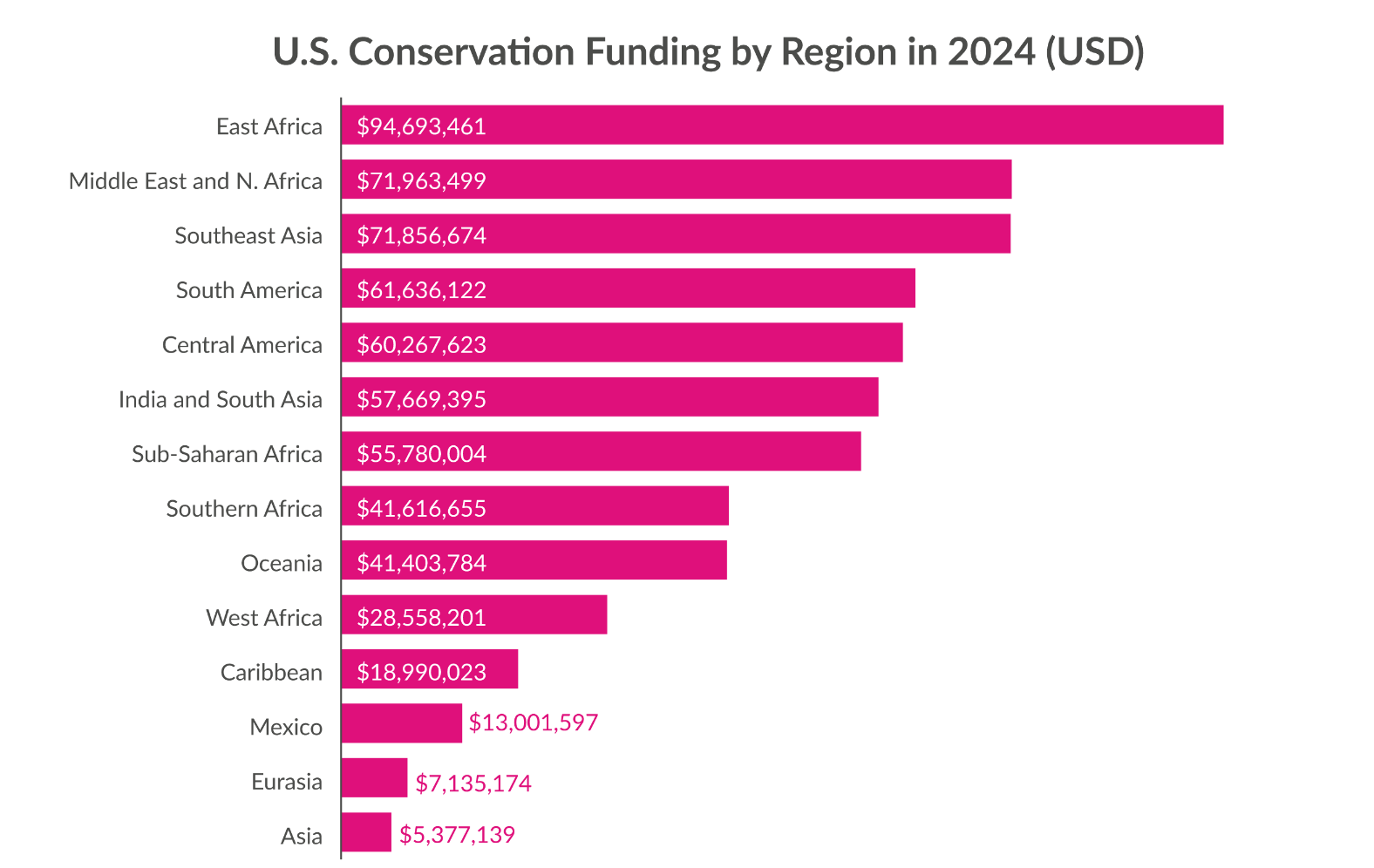
When USAID was dismantled early last year, there were enormous consequences for human beings, including the cutting of HIV/AIDS treatment. This funding cut has claimed an estimated 834,000 lives (two-thirds of them children) as well as $290 million lost for schools and clinics in Liberia alone. Beyond the human tragedy, USAID was the largest backer of biodiversity protection in the world and was a thrifty, inexpensive way to secure substantial conservation gains the world over. It directed $94,693,461 to East Africa alone, money which is now gone. This is having immediate consequences; for instance, the Society for the Conservation of Nature of Liberia paid guards to protect the forests. These guards are often directly recruited from communities that had previously economically sustained themselves through illegal hunting of forest animals. With the SCNL now completely without USAID funding, the fate of many threatened species is in doubt.
These four stories were incisive, well-written explorations into one of the most important ramifications of the slashed USAID funding, specifically that efforts to fund conservation — ordinarily a bipartisan goal — were gutted unilaterally.
The four stories we talked about are all worth checking out:
The Future of Conservation Without U.S. Aid - The Trump administration’s cuts to biodiversity funding have imperiled species, habitats, and the people who defend both. Now the world seeks a new way forward.
The Ghosts of Conservation Past - A look back at the United States’ outsize influence on global conservation reveals why the latest funding cuts should come as no surprise.
In the Wake of the Storm - A scientist tracks how cuts to federal funding are reshaping coastal communities, research, and species management in Alaska.
The Fight for the Heart of the U.S. Environmental Protection Agency - One year after the Trump administration threw the EPA into chaos, former employees continue to push back—and to dream of an agency reborn.
Krista, and each of these stories, can be found at bioGraphic.
This interview has been condensed and edited.
Krista, thank you so much for coming back on.
Yeah, great to be here, Walt.
I am such a big fan of what you folks do at bioGraphic all the time. I really, really enjoy it. And you guys are out with a brand new package that takes a big look into the state and the future of conservation in the world. Based on some very significant funding decisions made last year, it is now happening without a lot of the input and support of the United States. Do you want to talk a little bit about where the idea for this package came from?
Yeah, absolutely. So about a year ago, when President Trump was first re-inaugurated, we learned that USAID was being slashed along with the budgets of the U.S. Fish and Wildlife Service and U.S. Forest Service. Something that only one person on our team really knew, (which was news to the rest of us) was that these domestic organizations or agencies, like U.S. Fish and Wildlife and U.S. Forest Service, did significant work overseas.
USAID, of course, was almost exclusively overseas. People really think of them as being an agency that focuses on human health. It were also one of the world’s biggest funders of conservation around the world. It not only did its own direct work in countries all over Africa and South America and Asia and the Pacific, but it also funded all of these smaller-scale non-profits from local grassroots ones to much bigger ones like the World Wildlife Fund and the Nature Conservancy.
USAID and other U.S. government agencies were this major player in the way that conservation was carried out and funded around the world. Once we started digging into that and learned just how big the influence was and how long that these systems had been entrenched in global conservation and determining what got funded and how conservation was carried out, and then the fact that all of this was just suddenly being slashed, we were like, “This seems like it’s going to have some pretty major implications.” Even if some of these decisions about funding or the way that agencies operate are subsequently reversed or reinstated by other administrations, the echoes of what’s happening are going to reverberate around the world for a really long time.”
We thought it was worth doing a deep dive into this issue because so much of the coverage that we saw was focused on impacts to human communities. Of course, we didn’t want to undermine that work, which is also deeply important. But our beat is wildlife conservation and habitat. So we wanted to look at that stuff. We started digging in, and then we were like, what if we publish this in one year? There was a little bit of a flurry of coverage when the cuts first happened. But then people dropped the story because there’s always something new to report on, something new going on, especially in the United States these days with the political situation. So we were thought, let’s stay on this and see what the landscape looks like one year after this seismic shift, see how things are changing and how they might continue to change in the future. That was the genesis of this package.

It’s incredible. I really, really found it very fascinating. Let’s take a look back. There was one of the stories that you published called The Ghosts of Conservation Past by Jude Isabella. I thought that it was a really interesting history of the role of the United States in conservation and contained a ton of stuff to give us some grounding of where this stuff came from. Do you want to talk a little bit about that piece and, how the role of the United States is actually really considerable when it comes to just preserving land?
Yeah, for sure. I also learned so much from helping to edit this piece. I wasn’t the primary editor, but I read various iterations of it and helped out. Jude is also an editor at Biographic, so it was an in-house piece. As she was writing it, she was like, I feel like I’m writing a poli sci paper in college. It feels more like that than like I’m doing a reported journalism story.
But I think that was the treatment that this piece needed because it is so much about the history of how we got to where we are today. That was one of our questions that we set Jude loose on: how did we get to this point where the U.S. had such a huge impact on conservation and all of these other countries around the world? She started digging into it. It was initially supposed to be a shorter piece, but it just kept ballooning because she kept finding such interesting stuff.
She identifies a few different ways that the U.S. influenced conservation around the world. One certainly was through pure funding; we just threw money at places. Part of that was genuinely altruistic in some cases, but part of it was like a Cold War strategy or a way to increase global security. People who have intact ecosystems tend to be more financially secure, as well. Helping to secure these less wealthy countries and their financial situation goes hand in hand with environmental protection. So there was pure funding, no matter what the impetus behind it was. And then there was a lot of diplomatic work that happened. These international treaties to protect migratory animals began with the United States, and treaties to protect endangered species from being trafficked all originated with the United States as well.
And also through examples. Jude talks about the founding of Yellowstone National Park and how Teddy Roosevelt brought over the King of Belgium to tour national parks in the United States and show them as an example of Hey, this is what you could do with all of this territory that you have, for lack of a better word, in the Congo. Why don’t you make some parks there too to protect the gorillas?
That was a pretty novel concept at the time around 1916 or so. This led to the creation of national parks around the world. On the one hand it is really great, it did lead to the protection of the habitat of gorillas. But on the other hand, it is really complicated because Yellowstone was created by kicking out indigenous people. That same model was exported around the world to create these parks as fortresses where people were not allowed in, especially people who are indigenous to those lands. It’s a really sprawling story of all of the different tentacles that the United States has in the ways that conservation is practiced around the world.
Yeah, it was really interesting. I also thought it was so fascinating because it gets at some of the actual legislation that went through. This stuff passed by insane margins. The Endangered Species Act was basically passed unanimously through both chambers of government. And that just feels like a completely different era.
Yeah, absolutely. It’s become really politicized since then and Jude traces how that happened and the ways that the environmental movement got tied up with the free market, which I thought was also really interesting.

A lot of the argument of a these policies and the stories that you covered were about the truly global role of this funding. But America has vast, vast, vast areas of wild lands and those need management. You had a really amazing story called “In the Wake of the Storm” by Caroline von Hemert that really dove in on the implications of these research cuts in Alaska, which obviously has a lot of land — federal land and protected land. Do you wanna talk a little bit about how some of these decisions are manifesting in the United States as well?
Yeah, absolutely. Caroline is one of my favorite writers, so I was really happy to tap her for this piece, which we considered more of a perspective because it’s a little bit more of a personal essay. She was a biologist with the U.S. Geological Survey, and she decided to quit her job in April of 2025 when it became clear that she was probably gonna get fired anyway. Even if she didn’t get fired, the agency was just in shambles and morale was really low. She felt like her ability to do the science that she really believed in and to do it objectively was going to be compromised. She left her job. She subsequently went and sailed around Alaska. She has a really small sailboat and her background is as an outdoor adventurer, so she went on this sailing adventure and visited all of these sites that she had previously worked on during her decades as a biologist. She saw the ways that funding cuts are already impacting places.
People in Alaska frequently say that they’re on the front lines of climate change. It’s a bit cliché, but it’s also really true. Entire villages are slumping into the sea and being forced to move, and extreme weather is just extremely extreme in Alaska. Just to give one example, she had just sailed along the coast of Western Alaska near these coastal villages called Kipnuk and Kwigillingok. She had nice weather while she was there and then they continued south. Just after they left, this huge typhoon category four storm hit those villages. The storm changed course so quickly that residents weren’t able to evacuate. It was just absolutely devastating.
These communities were devastated. The federal weather balloons couldn’t have changed the storm’s course, of course, but it’s unclear what predictions they might have offered. Those weather balloons had been operated by National Oceanic and Atmospheric Administration, and they were grounded just before the storm hit. And so, she writes about how these people whose villages were impacted by the storm are not able to return home.
They are living in temporary housing in Anchorage, which is hundreds of miles away and extremely culturally different from these small subsistence communities where they lived. And they’re trying to keep their culture alive in the city and not knowing when they can return home. They also lost coastal resilience grants from the federal government that were specifically supposed to help some of these communities respond to storms and extreme weather events like this. She writes that these are not like federal scientists or employees who are being affected, but these are real people who are already feeling the effects of a federal workforce crisis. I thought that example was really interesting.
Yeah, definitely. I also want to finish a little bit on The Future of Conservation story that you all published. That story has some really, really interesting charts. I know that my crowd digs that. So if folks are interested, they should take a peek. What are the broad contours of the future of conservation without USAID?
Man. Well, I think that conservation is not going to end by any means. It’s not like everything is collapsing without U.S. involvement. But people are really having to get creative. There’s a chance that other wealthy countries (particularly in Europe, like France, Germany and Norway) are going to step up and contribute more money. In some cases, that’s already happening, but in other cases, those countries also need that money to shore up their own defenses as the global geopolitical situation becomes more unstable and precarious. It’s unclear how much money is going to come from them.
There’s definitely a lot more money coming from private philanthropies. That’s a bit tricky as well, because it’s just where the ultra-rich decide to spend their money. That doesn’t feel like necessarily the best way to decide what gets funding and what doesn’t. Otherwise, people are just being creative, moving money around like, “Hey, we were going to have this new field station, but now we are not going to have this new field station anymore. And we’re going to need that money to just keep our wildlife anti-trafficking patrols going and keep paying people.” There are some local people in places, like Africa and Indonesia, where they were getting their salaries were coming from USAID money. Without those salaries, people are potentially having to return to poaching or whatever they can do to keep themselves afloat.
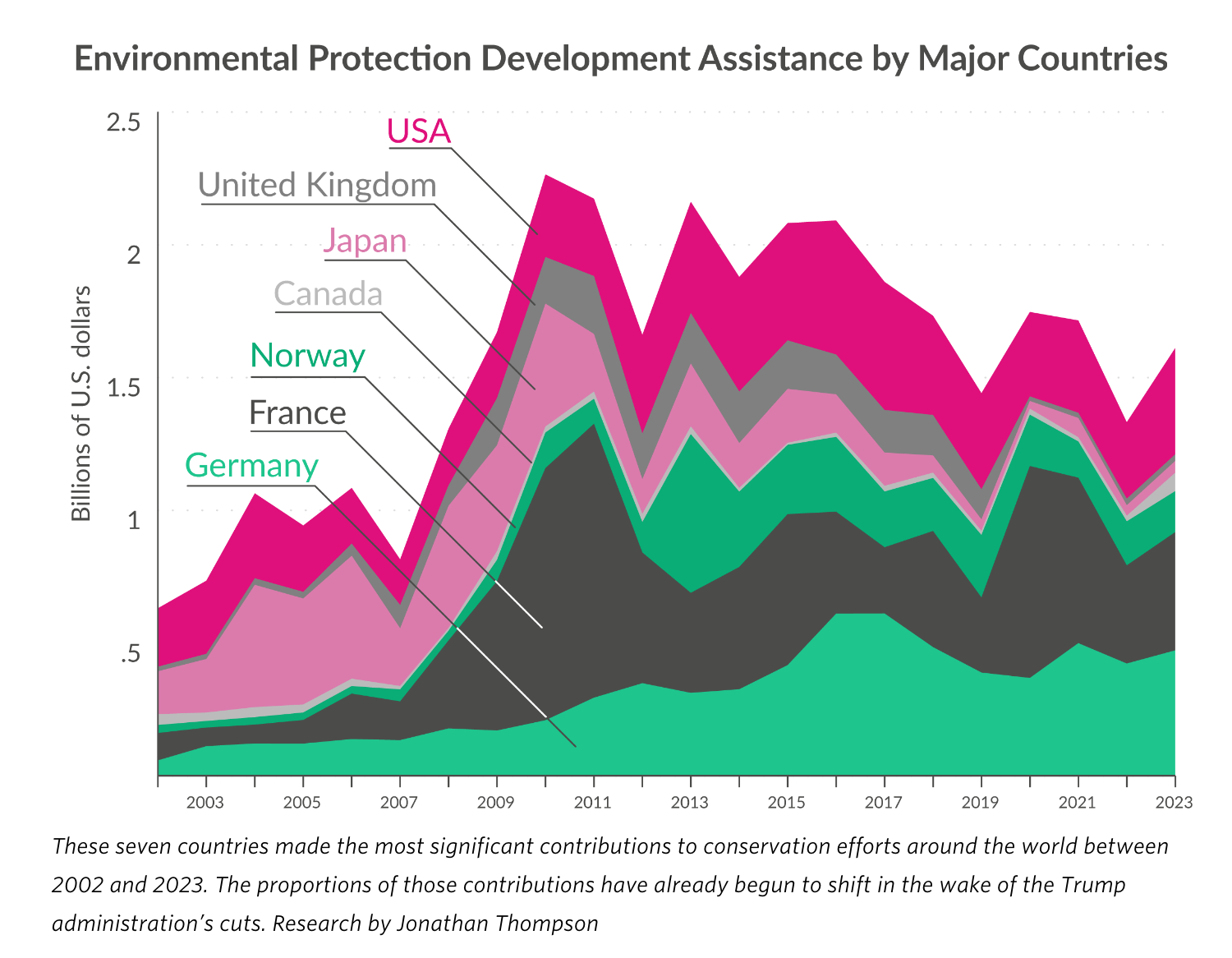
In some ways, it’s not as dire as it might seem. There are other sources, and people are being creative. On the other hand, it’s just a totally different landscape out there, and it’s not going to look anything like it did in the last handful of decades.
Yeah. The whole process has been extraordinarily disappointing for folks who are interested in supporting and having a natural environment. I did take away an element of hope from this story just because there was a part in it where it goes into just how anomalous the conceit that you should cut this stuff is. There was a bit in there about Rep. Michael McCaul, who was the Republican chair of the House Foreign Affairs Committee, who co-authored legislation to get matching funds for conservation.
This really is very much a bipartisan issue in favor of supporting and protecting these lands. This is just a minority of a minority attempting to, and successfully, cutting. But it was illuminating because a lot of times, it can feel very dejecting that half the country wants to cut this. But this is not remotely the case.
Yeah, absolutely. That’s something that has been hammered into me since I started out as an intern with High Country News, which is a magazine that covers the American West. A lot of Western states are pretty conservative. And yet, the congressional representatives from those states are still very in favor of protecting public lands and of protecting wildlife and habitat. Sometimes they will, while talking to their constituents, say something to the opposite effect. But then, when it comes time to vote in appropriate money for federal land protection… I mean, people who live in the West and who are surrounded by public lands, and that’s where they hunt. That’s where they fish. That’s where they recreate and go camping and hiking with their family and all of that stuff.
There’s just this inherent appreciation for public lands that a lot of members of Congress share, even though the party line often doesn’t reflect it. I think Congress is gonna end up being huge. Again, Michael McCall from Texas is sponsoring this legislation to try to bring some stability back into global protection for wildlife. Also, Congress has rejected a lot of the cuts to federal science agencies that the Trump administration initially proposed. Congress is going to play a major role here, and it’s going to be interesting to watch as it plays out.
Awesome, where can folks find the package?
At Biographic.com, we’ve got a page called Conservation Enters a New Era, and you can find all four stories there.
Thank you very much.
Edited by Crystal Wang
If you have anything you’d like to see in this Sunday special, shoot me an email. Comment below! Thanks for reading, and thanks so much for supporting Numlock.
Thank you so much for becoming a paid subscriber!
Send links to me on Twitter at @WaltHickey or email me with numbers, tips or feedback at walt@numlock.news.

To repeat a point I have made over and over, we absolutely suck as stewards of the planet.