
By Walt Hickey
Welcome to the Numlock Sunday edition.
This week, I spoke to Neil Paine, a Numlock regular and one of the most comprehensive sports writers I know. Neil covers everything, so we talked a little bit about everything. Specifically, it’s a real busy time for certain sports. We covered the NBA finals — exciting stuff for your local Queens resider — The Stanley Cup and the World Cup all in one go.
I absolutely love having Neil on, and as always, he’s writing and recording some phenomenal projects. You can find him at Neil’s Substack for daily updates on all things sports data, his Sherwood newsletter Scoreboard diving into prediction markets, and you can find him in your ear with his NASCAR podcast, Podracing.
This interview has been condensed and edited.

Neil, thank you so much for coming back on.
Thanks for having me again, Walt.
You are one of the most comprehensive consummate sports writers that I know. You cover everything. You have a newsletter, Neil’s Substack, that is a daily must-read for me and I think is just one of the most diverse spectrums of coverage that you can see out there. I feel like we have talked about this in the past, but you, I believe, are one of the only guys who covers both NASCAR and the WNBA regularly for large sports websites.
You’re telling me that the Venn diagram is not widely overlapping?
I mean, listen, perhaps there’s somebody in Indianapolis who covers the Fever and the 500, but I’ve yet to meet them.
Oh, I think Scott Agness, the guy who got his Fever credential pulled this past week, people should check him out on Substack. He covers Indiana sports, so he actually would cover the Indy 500, the Brickyard as well and then would cover the Indiana Fever. So he’s probably the other guy in that sliver of the Venn diagram.
We found him. But I wanted to talk to you because, we were just mentioning before we got on the phone, this is a particularly, secretly, extremely busy time for sports. We’ve got the NBA Finals. We’ve got our beloved NHL Stanley Cup Finals. And we’ve also got, imminently, the World Cup coming up. And again, your newsletter is just so fascinating in understanding all these topics. And I wanted to have you on to talk a little bit about what you’ve been reading, watching, writing, all that stuff.
Yeah, June becoming the stealthy busiest sports month of the year is interesting because it does usually contain a lot in terms of the NBA and NHL finals, and then also the drafts from those two sports. Usually, it’s two sports happening at once. And yes, theFinals, usually, it’s done by the middle of the month. Then you can pivot, especially after the drafts, to like the summer baseball, WNBA — the slower rhythm of things until football starts.
Here, you’ve got the World Cup. It’s back in its rightful summer place because the last time that we had a World Cup, because they decided to have it in Qatar, they had it in the winter to make it bearable. Now that it’s in North America — it’s in Canada, the US and Mexico — it’s in a more normal time of the schedule. But that puts it right in the middle of this summer stretch.
So there really is no off time that we got used to in the past. Everything is converging. And all the cups are runneth-ing over, I think, is the way to say it. But it’s exciting, especially because you and I together work on this prediction market newsletter for Sherwood News. And that has kept me plugged in with all of these different things that have odds around them. And you can keep up with it that way. It’s been interesting to see the evolution of who’s favored in each of these sports as time goes on.
I would love to dive into some of your recent work. I think, as a New Yorker, I am obliged to first ask about the NBA Finals, which features a Knicks team that you recently wrote about. About how they’ve tried to become a team that has historically thwarted their ambitions, as well as a Spurs team that has managed to completely rebuild on the fly really, really quickly. And just really makes this finals particularly interesting. Do you want to talk a little bit about what’s going on over there?
Yeah, in a lot of ways, these are polar opposite approach teams, where the Spurs previously were a dynasty with Tim Duncan and Manu Ginóbili and Tony Parker, and of course, Gregg Popovich as the coach. And they’ve spun it forward. I made the comparison, which I know a lot of people are going to hate, people are rolling their eyes. But the New England Patriots, it’s similar because we saw them in the Super Bowl. We saw the Spurs now coming back to the NBA Finals.
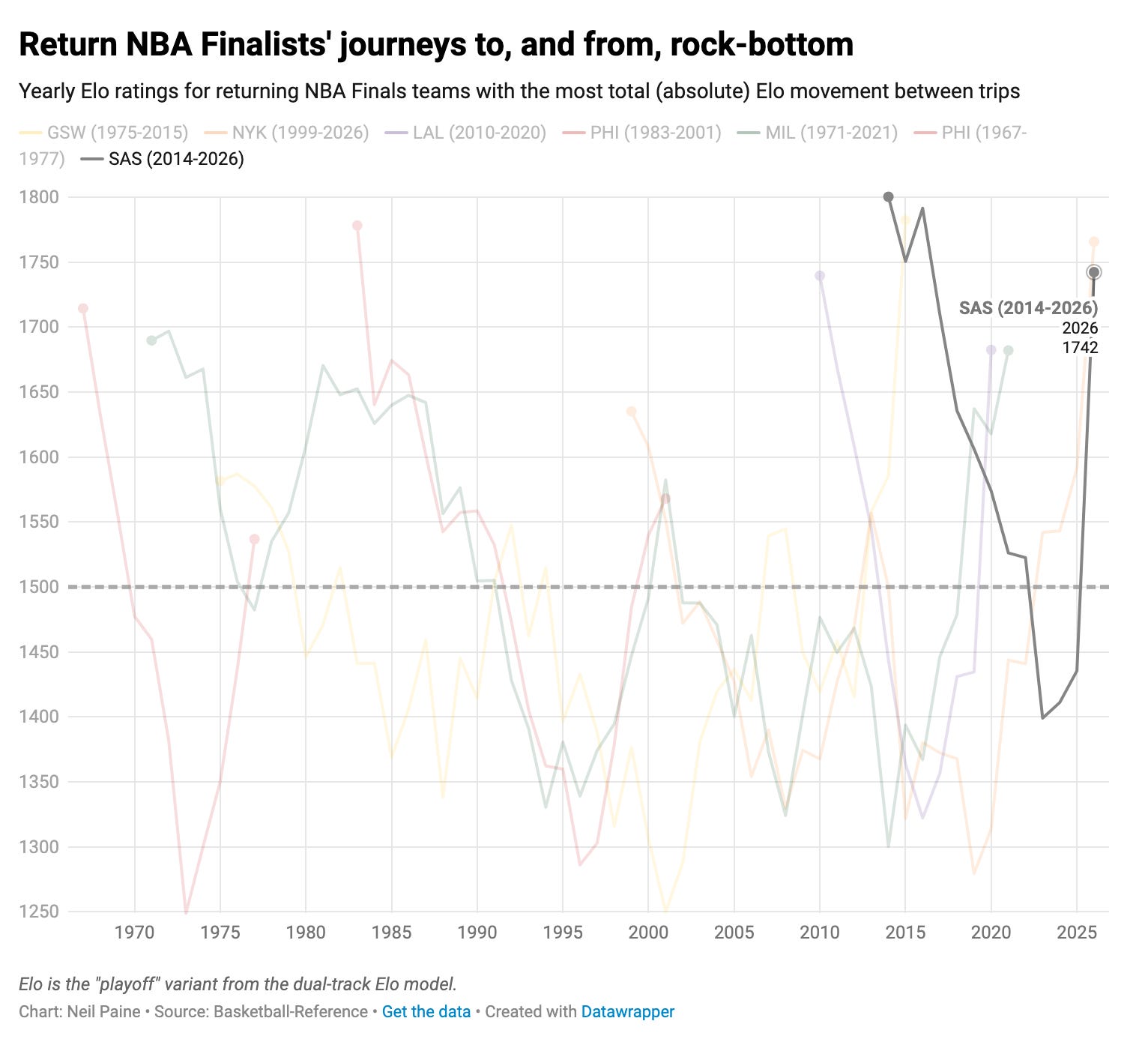
And it’s like, okay, great, we didn’t even have time to really reset ourselves and these dynasties from the 2010s are like back in our lives and back in the championships. But the Spurs, once they got Victor Wembanyama, who is the most just uniquely great player in NBA history, I think it’s already fair to say that a 7-foot 5-inch guy that can shoot threes, go inside, block shots and just has this force. He really is like a video game creative character if you sat down in “2K.” I was joking about this with someone where it really was like this guy only existed as a created character in these video games in the past. And now he actually exists in real life. And you’re like, how is this real that this guy exists?
It reminds me of like John Bois’s “Breaking Madden,” where you would just turn a slider all the way to one end.
Dude, yeah, the Victor Wembanyama sliders are like height maxed out, BMI minimized and then all of the other stats are maxed out that you wouldn’t even expect from a man that size. And the effect is this guy is like a game-changing force. And that really has defined the Spurs. Like many teams that rebuilt, they hit a pretty low point in their recent history. And that allowed them to get the number one pick. It happened to be in the year that Wemby was available, and they were able to draft this all-time generational prospect. Then he has panned out in a way that not every super tall player has. A lot of these guys face injury concerns, whether it’s Yao Ming, Ralph Sampson was someone prototypical Wemby back in the ’80s. A lot of these guys ended up not being durable enough because the human body is not necessarily meant to be this big and still be able to be that mobile and stay healthy.
And right now, knock on wood he’s pretty young and early in his career, but he has stayed healthy enough to be this MVP-level player. He knocked off the Oklahoma City Thunder who were this budding dynasty, and instead sent them home, guaranteed that there would be an eighth consecutive year with a different NBA champion, which is the first time that’s ever happened in history. It’s this meteoric rise on one side.
And then on the other side, you have a Knicks team that had been banging their head against a brick wall for years and years and years. They went out and they got Jalen Brunson a handful of years ago, and that kickstarted this current process of the Knicks actually being good, which has been rare this century. But every year they just came up against a team, usually the Indiana Pacers for some reason. I don’t know why, but they kept going up against these teams that would beat them. They would have home court advantage, they would still lose. And it just felt like they had maxed out their potential.
Then they changed coaches this past off season from Tom Thibodeau to Mike Brown. That, along with trying again, you just keep trying, I guess this is a testament to stick-to-itiveness, but the Knicks finally got their breakthrough. And it’s very rare to have teams do that.
My piece that I wrote was, ironically, the last team to win this many games in the playoffs over a three-year period and not make the finals, and then make that leap in the fourth year was the Michael Jordan Bulls in 1991. They made the leap to the finals finally and answered those questions of could you build a great team around Michael Jordan? Which is an insane question to think about that people actually ask, but they did ask that. There were legitimate reasons to think, hey, maybe this guy is just maxed out at the Eastern Conference Finals. The Pistons kept beating him. He breaks through, obviously wins a lot after that. And the Knicks are the next team.
I obviously don’t think Jalen Brunson is quite as good as Michael Jordan. That would be a little bit of a hot take. But he epitomizes this whole idea of, you don’t have to be what people think you are from the beginning. He was a guy that was not overly well-regarded coming out of college at Villanova. He was picked 33rd overall during the second round. And he has just progressively grown into a far greater player than anybody thought he could be at multiple different stages.
When he went into the NBA with Dallas, people thought, can he actually even stick in the league? Then he proved that he could do that. Then it’s like, well, can he really be a starter? He was the sixth man of the year one year. And then he proved he could be a starter on a team that went deep into the playoffs. Then he signs with the Knicks at what is in retrospect a pretty bargain-basement deal. And people are like, can you really actually be the best player on a team? Well, he is the best player on a team, but they keep losing the playoffs. So then it’s like, yeah, can you really make the finals or win a championship with him as your best player? And then he comes out and is in the process of trying to prove that wrong.
So he is just proving doubters wrong at every different turn of his career. And that’s different from Wemby because Wemby almost hasn’t had doubters because you just take one look at a 7-foot-5 guy like him, and you’re like, well, obviously this guy is gonna dominate basketball for our lifetimes, basically. So it’s a very interesting juxtaposition of the two teams who, I think, are the two best teams. Oklahoma City had every chance to put San Antonio away and they’re up three to two on them. Then they lost two straight games, put away games and really showed up small in game seven. And Wemby and the Spurs stepped up big. So I think it’s a great matchup.
I also like how I leaned into this in our newsletter of the idea of like most of the time when Hollywood revives a franchise with a reboot from the late ’90s, it’s just an absolute disaster and sad. But in this case, this is a rematch of the 1999 NBA finals, and I think it already has shown that it has the potential to be far greater than the original, which ended in five games. The Knicks just didn’t have enough to be able to beat the Spurs. The Spurs went on to become a dynasty from there, and the Knicks went on to become nothing from there. They progressively slid into oblivion. I think in this case, it could be a much better series and maybe much brighter futures for both teams.
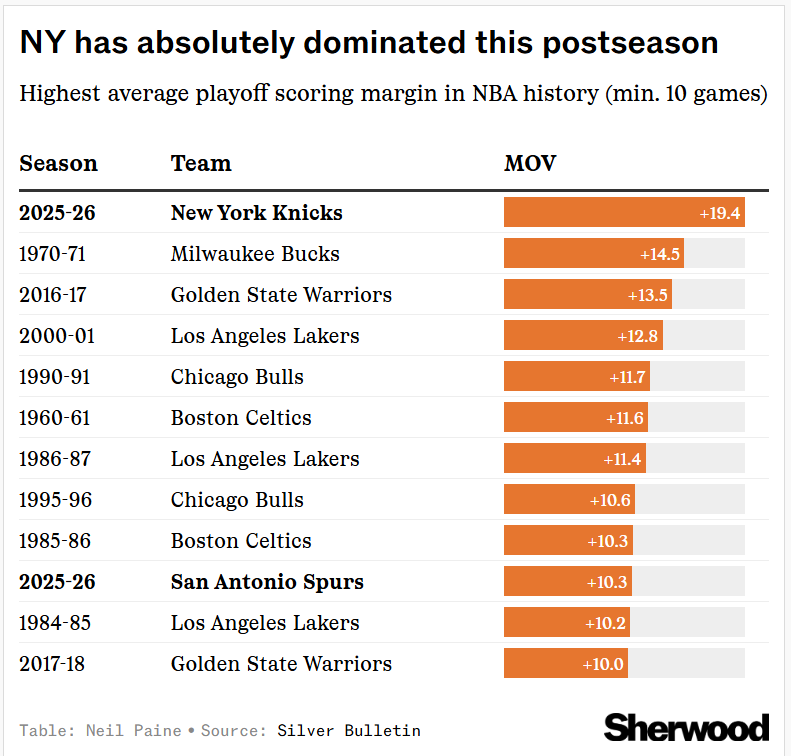
Yeah, I mean, listen, New York has an energy to it right now that is tough to describe. It’s fascinating what’s happened to these two iconic New York City institutions of the Knicks and the Roman Catholic Church when you some guy from Villanova on top of them.
Yeah. I know the Yankees have won, obviously, the most championships of any New York team. And the Rangers get people pretty fired up at different times. But I really think there’s something about the Knicks and maybe something about New York as this basketball mecca that when they’re good, people just freak out. They go crazy. It’s a little like an average Philadelphia Eagles postseason-type of reaction. But when the Knicks are good, the city of New York they go a little wild over it.
And I like to see because whatever the true spirit of New York is, I think the Knicks are the team that most typifies that. Despite having just the shittiest owner with Jim Dolan. It defies explanation, how the combination of that ownership and the team’s place in the heart of New York. But maybe that’s like, you suffer longer, it makes it sweeter when you actually taste success.
Yeah, and now he’s got his Sphere distracting him from actually running this team. So it’s been good lately.
I wanna turn our attention to another finals going on right now, which is the Carolina Hurricanes and the Vegas Golden Knights. It’s a good looking Cup, man. I’ve been really enjoying it. I mean, these games have been nail biters and I know that my friends in Carolina have been really, really sweating this one, but it’s been extremely enjoyable. We are having this conversation on Friday.
This interview is running on Sunday, so information will have happened in between our conversation and when people will be necessarily reading this. But it’s been a hell of a Cup to watch.
Yeah, I assume that Saturday night’s game will also feature one team going up two to nothing and then blowing that lead because the first two games featured that. [Ed note: lmao.]
And that’s actually the first time in the history of the finals that both of the first two games of a series had a team blow a two-nothing lead and eventually lose those games. It happened to Carolina in the first game and happened to Vegas in the second game. These have been wild shootouts. They’ve been back and forth. In each third period, there’s been a lot of lead changes and tying goals and things like that.
There was a controversial no-goal that then the coach of Vegas, John Tortorella — who is also just like this fiery, interesting character, I think it’s fair to call him — he did a replay challenge, failed the challenge, and it not only took away a goal potentially if they had gotten the challenge overturned, it could have been a goal for him. Instead, he took a penalty because he was wrong in the challenge and then Carolina scored on the power play and that ended up changing that game and Vegas ended up losing that game.
But it’s been this high-scoring, high-octane series. And that’s in contrast to how both of these teams were, leading up to the finals where their goaltenders were really dominant, Freddie Andersen and Carter Hart. But as I wrote and have been focusing on, there was always a sneaking suspicion that either one or both of these guys were going to turn into a pumpkin at some point because they were both playing way above what they had done during the regular season. Andersen was one of the worst goalies in the league during the regular season. Hart was his team’s third string goalie at one point during the season.
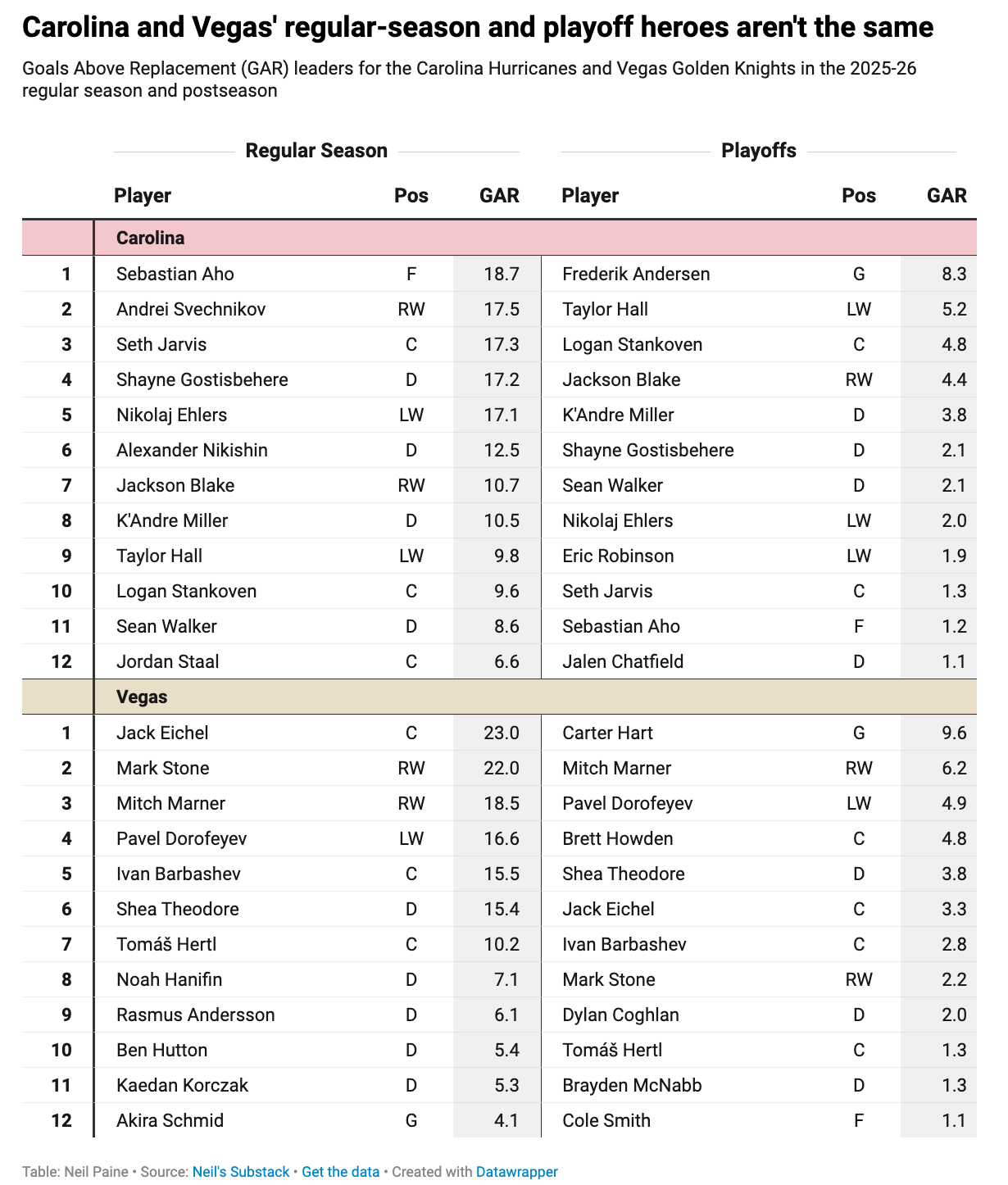
So you were like, yeah, this is gonna persist. And we’ve seen it not really persist and there’s a lot of reasons for that. But that has added to the flavor of it. And then I love the story of this guy, Brett Howden of the Vegas Golden Knights who had one goal in game one, two goals in game two and has had, I wanna say 13 goals. As of when you read this there’ll be an additional game, he’ll probably have scored a hat trick or something.
But going into that game three, he had 13 goals which was actually more than he had during the regular season. 13 in the playoffs, he had 12 in the regular season. Among players that had 12 or more goals during any regular season in the history of hockey, his 13 playoff goals is the most of anyone for players who had more playoff goals than regular season goals. This guy is turning into a completely different player during the playoffs than the regular season. And we see that kind of often in hockey, maybe not quite to this extent. Your stars, you can count on them to some degree, but mostly it’s who crawls out of the woodwork and puts together these heroic performances.
One of the charts that we ran in the newsletter around the Brett Houghton thing showed that Claude Lemieux was also heavily on that list of guys that scored more goals in the playoffs than in the regular season. He died, unfortunately, in the past few weeks. He was one of the great clutch performers in hockey history. It’s a tribute, I think, to see him show up on these lists because he was the epitome of that kind of player. Certainly a good player during the regular season, and he was useful to have on your team, but when you signed him and traded for him, you knew that you were gonna use him in the playoffs and he was gonna exceed all expectations when the calendar turned to April and May and June.
He always seemed to deliver, and that’s why he won so many different Stanley Cups. I think he won four Stanley Cups for three different teams, which is pretty rare. I’m not sure how many other guys can say that.
Yeah, reversion to the mean being one of the most powerful forces in the universe. You have told me in the past, listen, it’s just oftentimes who’s hot during the playoffs, what goalie’s hot, what goalie’s able to stay hot. Hockey is very fun to watch for that exact reason, so I’ve just been really enjoying it. This has been one of the most watchable Stanley Cups, I think, in quite some time.
Yeah, and one other thing about the Golden Knights is they fired their coach. I mentioned John Tortorelli, he did not coach, like, 95 percent of the games for this team during the season. They fired their coach, it was one of the latest coach firings in recent history, only later surpassed by the New York Islanders firing their coach like a week later this season with two games left in the year. I don’t know if this is a case study that you can apply going forward, but every time I see Vegas win more games in these playoffs, I’m like, man, a lot of teams are gonna look at this. Usually, in the past, if you were a coach and you were gonna go to the playoffs and you were a playoff-bound team, you could probably feel like you weren’t going to get fired with eight games left in the regular season, that was probably a pretty safe bet.
Now, all bets are off. I think teams are gonna look at this and be like, you’re not safe. We might fire you during the playoffs. We can fire you at any moment. Don’t get too comfortable coaching these teams. I don’t know, it’s a copycat type of sport, so I wouldn’t be surprised to see that.
Did that work? I guess it did in this case, because he did push some different buttons than the previous guy that seemed to have gotten them to this point, but at the same time, you were talking about the powerful force of regression to the mean. Maybe the regression was positive for Vegas because they underachieved the whole year, and once you get to the point where you’re desperate enough to fire a coach, that’s probably also the point when the regression positively sets in and you start to play like you were actually supposed to play the whole year.
Yeah, I enjoy how generally hot seats are in coaches for hockey, but this seems to be dialing that quite hotter than it had been in the past.
And hockey coaches, I believe, have the shortest tenure on average of any pro-league coach. I think it’s only like two and a half years on average, which is crazy, and winning Coach of the Year is one of the biggest curses. You do not want to win Coach of the Year because they have a shorter lifespan from the moment they win that award going forward than the average coach. Think about that. You were just named literally the best coach, and that means congratulations, you have less job security going forward than if you were just not even in that conversation as the best coach. Isn’t that fucked up?
That’s dead man walking. Incredible. That’s great.
I would like to finish with looking forward. I think a lot of this summer is gonna be talking about the World Cup. You had an extremely interesting story in Neil’s Substack, which, again, I highly recommend folks read, as well as reading Scoreboard, which is a very fun thing that we work on together, more focused on prediction market stuff. But Neil’s Substack, you had a very good post. Is the U.S. men’s national team finally ready for a breakthrough? I remember one of my about working to at FiveThirtyEight was that we would oftentimes have question headlines the answer to which was “uh, no.” I guess I would just put it to you. Is the U.S. men’s national team finally ready for a breakthrough?
Well, I didn’t say that they would win the World Cup, so I’m not automatically setting myself for Betteridge’s Law of Headlines. If there’s a question headline, the answer is always no.
I think they could be ready for a breakthrough if we define it as getting past the round of 16. So this is, I think, a really interesting World Cup. First of all, the U.S. co-hosting, we mentioned that earlier. They’ve lost in the round of 16 in three of the past four World Cups. They also didn’t qualify for the 2018 World Cup. We don’t talk about that.
But the question is have they hit this ceiling? They have not made the quarterfinals since 2002. Why can’t they get further than that? They just keep running up against teams where there seems to be a talent issue. They just can’t quite get it done at the end of these games. And they have made incredible progress. I say we will be jingoistic here as Americans. We had let our soccer program go to absolute shit in the ’60s and ’70s and even into the ’80s. We missed nine straight World Cups at that point.
Once we started to actually take it seriously, we made incredible progress leading up to the 2000s. But if you look at things like the ELO rating, which tracks how we’re doing over time, we have stalled out. We’ve hit a plateau. That might suggest like, well, why do we think that we would have any more of a chance this year than any other one? Well, the host country effect is pretty strong. It doesn’t seem to get diluted. They looked at this for 2002 when Japan and South Korea shared it. They both got the same effect that you would expect from a sole, no pun intended, host. So I have reason to think that the U.S. will get at least some boost from playing at home.
Also, the format has changed. And I think it’s a lot friendlier to at least making it out of the group stage, which at certain points has been a problem for the U.S., especially before this recent run of like hitting the round of 16. We would have loved to make the round of 16 at different times and couldn’t quite get out of the group stage. This year, because it’s expanded to 48 teams and there’s more groups and they also let third place teams from some of the groups. So in the past, you would only get the first two teams from a group to make it in. Now you can finish third in a group and still make it out.
So there’s a lot more chances to make the knockouts than there used to be. If you look at Polymarket, the U.S. has an 84 percent chance to make the round of 32, which would be your knockout first round instead of the round of 16, like it used to be. They also have a 46 percent chance to make the round of 16, so it’s kind of a coin flip whether they’ll get back to that usual spot. Then a 21 percent chance to make the quarterfinals. That’s not nothing.
If you look at who they might play, some of the draws are conditional on making the round of 32. They could be set up to have a decent shot at making the round of 16 and then going from there, hilariously or just ridiculously, they could play Iran. So think about the awkwardness of geopolitical sporting events so far. We played Canada in both men’s and women’s hockey at the Olympics. We played Venezuela for the World Baseball Classic and lost.
Now, somehow, it’s not hard to conceive of a situation where we finished as the runner up in our group, Iran finishes as the runner up in their group, and then we actually play each other in the first round of the knockouts in the World Cup.
I’m gonna push back on you a little bit because I think that what you’ve hit on is basically a version of the birthday problem, right? There are a lot of countries that we’ve pissed off. We could have drawn Denmark. I think it’s like one in nine countries have been menaced by the United States in the past, perhaps, one and a half years.
I wonder what happened one and a half years ago that caused that. But no, you’re right. If you start enough geopolitical conflicts, eventually you will play a team that is involved in that for one of these sporting events. But it would be just completely ridiculous. They could also play Switzerland, which would be like, okay, let’s go up against a neutral country, see what happens from that.
But the point is that the biggest reason to think that we could actually have this breakthrough is we just have more talent than we used to, relative to the top teams. There’s this great site, which is, I always look at the translated form of it, but it’s originally in German. It’s called TransferMarkt. So transfermarkt.co or whatever it is, gives a rough valuation in Euro to each player in major professional soccer. And when we lost to Belgium and Germany eventually won the World Cup in 2014, the collective valuation of our roster was just 10.7 percent of Germany’s total roster. So the value of our guys. And we didn’t really have that many guys in the European major big five leagues and all that stuff. We had some, but the majority of our roster were playing in the MLS and they were playing lower tier types of soccer leagues.
Now, if you look at us compared with France and Spain, those are the two co-favorites – if you look at a place like Polymarket, they’re both I think 16 percent each to win the World Cup — we are 25 percent of France’s total in our roster and we’re 32 percent of Spain’s total. So we basically tripled our talent relative to the top teams in the world since 2014, which was the time when I wrote the story for FiveThirtyEight about why we aren’t better at soccer.
So to me, that, in combination with manager Mauricio Pochettino. I know many coaches have tried to instill like, hey, let’s play a more advanced and less caveman-like style of soccer. And the results have been mixed at different times over time. But the reporting going into this tournament has been like, we really are trying to play this more modernized, fluid, complex style of soccer.
Now, I don’t know shit about soccer tactics. I’m not gonna sit here and pretend that I know that much about it. I’m an uneducated American casual. But I will say, most of us are, as an American, casual soccer followers. But I will say that anytime that you have these reports about there being more talent, they’re trying to put in a more style that harnesses them more, it does seem like a good sign. In the past, we were characterized by our toughness and being counterattacking and all that, which is code for we suck and we never have the ball. And for us to score, we really need something to go bad for the other team.
I’ve always heard about how good our goalies are, which is usually a sign that they’re very, very well tested.
Yeah, exactly. If your best player is your goalie, which I think was true for Tim Howard and guys like that in the past, that’s probably a bad sign for soccer. So that all points to like, maybe we can do something, even if it’s not making it past the round of 16, just in terms of being more competitive. Maybe we’ll win a group, but that is another factor that we could look at here because of the way the draw shook out. We’re in group D, we have a fighting chance. We’re the favorite. Granted, we have the plurality but not the majority of the odds where Turkey is also in there.
So we’re at 39 percent to win the group. Turkey’s at 34 percent, Paraguay’s 18 percent, Australia’s 10 percent. So we’re favored to win a group. And if we win that group, then that changes the math around who we end up with. I wrote something for Polymarket about how in the past we talk about groups of death, this idea of through the draw or through FIFA’s shady under the table payments that they’ve accepted — not that I’m accusing them of that but would we really put it past them — you end up in a group with either harder or easier teams depending on how things shake out.
That has, through no fault of your own, this huge ripple effect on your chance of actually doing something in the tournament, making it out of the group stage even now. I think there’s paths of death, there’s not groups of death because if you go to the Wikipedia page for for the 2026 World Cup, I defy anyone at first glance to make heads or tails of their table of what happens with certain third-place teams or who plays someone depending on where they finish in the group.
It is just this insane matrix of different possibilities where if you win your group, then you might get matched up with the third-place team from one of five different groups. But if you’re the runner-up from the same group, you end up on the opposite side of the bracket against the runner-up from a different group. But if you finish third and you have the goal differential to beat out the other third place teams, then you’ll end up playing the winner of this other group.
I am shocked that European bureaucrats have come up with a system too convoluted, though that delivers a lot more equity, for Americans to understand.
I do think that there are certain situations that set themselves up where teams can, by virtue of being favored to win a group who they would play if they were If they were to win the group and then like how that would shake out from one of the other groups, they can get screwed now not just in the groups, but they can get screwed in the knockouts because of how they’ve been set up to kind of play different possible teams.
This wouldn’t necessarily be screwing the U.S. it would actually be pretty good for them in terms of being favored, but them possibly being matched up with Iran, there’s a bunch of stuff that would have to happen for that to play out. But that’s the case with every permutation of who you might play in the knockout bracket. I think there are paths of death where you can end up playing tougher teams. Despite winning your group it may actually be more beneficial to finish second in your group than to win it. We might see some weird tanking or some weird chicanery around where you end up in your group, as well.
So it adds this other layer of complexity to it by adding a bunch more teams, a whole new knockout round and more ways to get into the knockout. I didn’t see anything wrong with the old system, but you have to make sure that you get the host teams into the knockouts, if you’re FIFA, and get more money for more Confederations and so on and so forth.
Well, it’s gonna be very fun to watch. I congratulate them on their incredibly successful corruption. It turns out that the solution for American success is tighter integration of our labor with international businesses and importing high-quality talent from overseas. Who would have known?
That is true. A lot of the American coaches, including Pochettino, have come from other countries. We’ve had our share of American coaches for sure, but it does seem like our greatest periods of improvement have come when we have a non-American coaching team U.S.
Klinsman was not everybody’s cup of tea, but nevertheless really did seem to make a pretty substantial difference in the soccer development program in the United States.
Yeah, I think that you can point back to him and others as being pointing us in that direction toward being more like the best teams in the world, playing more like them.
Well, it’s gonna be very fun to watch. I would love to talk more, but we’ve gone a little long anyway. But honestly, it’s just always nice to chat, man. Generally, where can folks find you? I know that you can be found in people’s inboxes and in their ears and in lots of different places, so why don’t you rattle them off?
You can find me at neilpaine.substack.com, where, like you said, I write about kind of everything. Also Scoreboard for Sherwood News, check that out if you like to get a daily dose of prediction market-related content. I write a weekly column for nascar.com, which is, if you like auto racing, you can check that out. We do a podcast called Podracing, me and Tyler Lauletta for NASCAR, as well. If you haven’t gotten enough of me from these like umpteenth million other places, you can listen to me talk about NASCAR as well.
Edited by Crystal Wang
Excellent Sunday edition. Always great to get a fivethirtyeight reunion! I start every weekday off with Numlock and Neil’s Substack