
By Walt Hickey
Welcome to the Numlock Sunday edition.
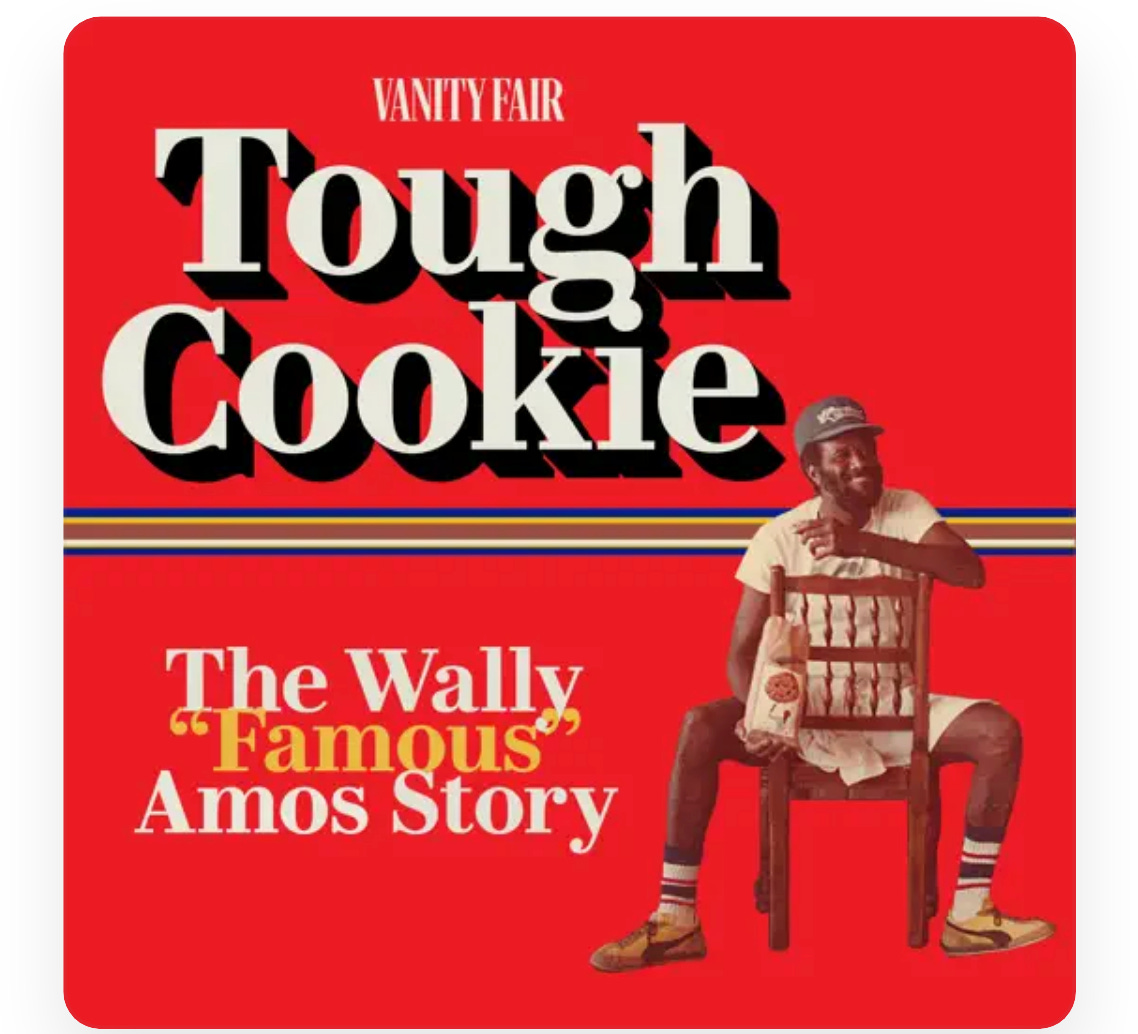
This week, I spoke to Sarah Amos, who produced and hosted the podcast Tough Cookie from Vanity Fair.
The show is excellent, it’s a personal story exploring the chaotic life of Sarah’s father, Wally Amos, who created the Famous Amos brand of cookies and built it into a nationally renown brand. The story doesn’t stop there, though, and talks about Wally’s troubles operating the brand, the lack of wealth that followed its sale, and the years he spend reckoning with the vast gulf between “famous” and “rich.”
The show can be found wherever you get podcasts.
This interview has been condensed and edited.
Sarah, thank you so much for taking the time to chat.
Oh my god, Walt, thank you for having me.
It’s been a minute. We worked together a couple of years ago.
Many years ago. Let’s not age ourselves, though.
You were doing documentaries at Vanity Fair.
At Condé Nast overall. I do documentaries, film and TV series across all the wonderful brands here at Condé.
You’ve had an opportunity to do a very personal story. It is called “Tough Cookie.” What is your relationship to this story?
The “Tough Cookie” in question is my father, actually. My dad was Wally Amos, and he founded Famous Amos Cookies back in 1975. It’s actually the 50th anniversary this year of the founding. And he passed away last year after a long and colorful and complicated and incredible and deeply infuriating life.
Rather than go to therapy and work out my issues privately, I made the frankly insane decision to rope my entire family into a journey through my dad’s past and our lives and emotions and all the things that we had never really dealt with in the very public setting of a six-episode podcast.
Yeah, it’s a phenomenal show by the way. I clicked it because, again, we go back. When I got into it, I was completely locked in immediately.
You know what? Family drama is the most universal storytelling device ever. I think the thing I tried to do with it is just bare it all: the good, the bad, the uncomfortable, the shit about myself that I am not particularly proud of. My gamble and my hope was that if I put it all out there for audiences, they would connect with it because it would feel authentic and real and just messy enough that you couldn’t stop listening.
It’s an interesting story of money and business and family. Just a guy who always seemed to be on the move from what was going on just immediately behind him. Where did you even find a way to start with this story?
I think I knew I wanted to tell the story of my dad’s life because it wasn’t one that I had ever really paid enough attention to growing up. I think I was raised in the downward years of my dad’s success. Because of that, I really ran away from his story. To me, so much of it was bankruptcy and failed cookie companies and divorces and more divorces. Once he passed away, I realized I’d never read his autobiography. I couldn’t tell you the basic foundation of how Famous Amos had started. I knew less than the Wikipedia page.
I was like, “Okay, let’s start with him. Let’s really go back and understand him and his story.” Through doing so, my goal was to hopefully learn from his mistakes, understand more what he did right or wrong and be a better person. What ended up happening is that I learned a lot more about myself and realized a lot of the things that I wasn’t dealing with in my own life through finally facing my dad’s death, which was a lovely benefit.
I want to talk a little bit about the fame part of this, because I feel like fame is so central. Obviously, Famous Amos is the brand, but it really seems like fame was something that ultimately defined your father’s life in a way — because it was something that he really loved a whole lot. The job that he had before he was a cookie entrepreneur was at a talent agency. Do you want to talk a little bit about his time there?
Yeah, he was the first black talent agent at what at the time was the William Morris Agency, now WME. He was the first guy who discovered Simon and Garfunkel. He went on tour with the Supremes. He was friends with Sam Cooke. He lived this heady life, but he was always on the periphery of fame. He was helping people be famous, but not being famous himself. I talked to one of his first clients, a woman named Pat Finley, who was a longtime family friend. She goes, “You could tell he always wanted to be in the spotlight more than necessarily managing those of us who were.” I think with Famous Amos, he finally found that.
He uses the idea of starting a cookie company (and his talents and his understanding of how the entertainment business works) to turn the cookie and himself into his client. He markets his own charm and his own charisma and fame and this cookie to turn it into a wildly successful business. But the problem is that the foundation of the company was based more on his fame than it was sound business practices.
You, more so than many, know that that is not the way to run a successful business. In so many ways, the fame and his love of it and his understanding of it are what led him to success. But it also became a bit of his downfall.
Yeah, there’s a part of it where he’s in the Macy’s Thanksgiving Day Parade multiple years, but also doesn’t seem like he’s got a grasp on the P&L element, and how to actually operate some of the business stuff.
Yeah. Look, he’s a kid who didn’t graduate high school, got his GED and surrounded himself with people he thought he could trust — some of whom he could and a lot of whom he couldn’t. He put the perception of success ahead of the foundational principles of running a business. They were constantly behind on payroll. They were constantly borrowing money to pay off old invoices; they were always one step behind, always in the red. And scaling constantly. The brand became more and more famous, but there was nothing underneath it to actually support this growing company.
Eventually, he lost it all to a variety of venture capitalists and investors who came in, bought him out and transformed the company into a very different product that he no longer wanted to be a part of. Frankly, had they not done that, I don’t think the company would have existed past the ’80s.
One of the most interesting parts of the story is that it seems like wealth and fame are oftentimes inextricably connected in our understanding of both wealth and fame, right? Wealthy people are famous, famous people are wealthy. At the midpoint in your story, your father becomes an individual who’s very famous but is not particularly wealthy. That seems to be an albatross on his back for the remaining years of his life.
It’s actually something that I really wanted to explore because I grew up in that world, right? I grew up with this extremely famous dad, whom everyone assumed was rich and, therefore, assumed I was rich. But really, all we had was fame and no money. Someone told me a quote (I think it was Bill Murray) that if you can be rich but not famous, take that because you can buy all the things that famous people have. There’s real truth to that, right?
My dad loved the fame because he loved people. He loved helping people, and he could use the fame in literacy; he could use the fame to make other people smile in a day. The fame gave him a sense of importance. I think it goes back to him being a poor black kid from Tallahassee, Florida, in 1936. He was told he was worth nothing. Fame is the easiest and quickest way to feel like you are worth something. The flip side is that he chased fame at the expense of money and at the expense of sound business decisions.
I have sought to do the opposite. I have always worked a job that has a 401k. I have always gone for health insurance. I have never taken risks with my own career because I so desperately want the financial stability that my dad felt wasn’t as important as the fame and the people and the success and that type of glory. Everyone has to make their own definition of it.
One of the things, hopefully, that comes across in the end is I always thought my version was right and my dad’s version was wrong. Only in doing this podcast have I begun to realize that no, you can have whatever version you want as long as you’re willing to live with the consequences and potential fallout of that. But that’s everyone’s choice to make. And it’s not a binary thing.
You have that whole pyramid of needs, right? If you’re only serving the need at the top — the apex — it doesn’t have any foundation. So it’s inherently chaotic, but it’s a way of addressing a deep-seated need that he had.
My dad definitely did just focus on the need at the very top. But that was the choice he made. Part of me has to just accept it.
You mentioned earlier about some of the philanthropy. But he was a real innovator when it came to cause marketing.
Yes. He is actually also on the Wikipedia page of cause marketing.
Can you also explain what cause marketing is?
Yes, so cause marketing, for those who may not be familiar, is everywhere in our lives now. Tom’s Shoes, Warby Parker, those are cause marketing companies. When you go and buy something, they are also donating a product or a portion of the funds to a charity or a place that is in need. Ben & Jerry’s is one of the most classic cause marketing companies.
I’m literally wearing Bombas right now. It’s everywhere.
In 1975, no one was doing cause marketing. Companies were for-profit, and that is all companies were for. My dad had no marketing budget and no PR budget. They thought, “Well, we can get attention if we have you be a spokesperson for a good cause. Because it will put you out there constantly. It will put you in the public’s mindset. And at the same time, it will put our company in the public mindset.”
My dad had always really cared about literacy. Neither of his parents knew how to read until they were adults. He got involved with Literacy Volunteers of America. For 20 years was the spokesperson for them. It became his life’s work. Reading became the thing that was most important to him: teaching kids how to read, teaching adults how to read. The reality is that it all started mainly out of a desire to promote cookies, which is funny. Cause marketing really helped turn that company into a success. It really created an entire industry of companies that exist now.
It was a really fascinating moment of like, “Oh, somebody had to discover this.”
Yeah, and Ben & Jerry’s, to their credit, came up right at the same time. I mean, they maybe even started like a year or two earlier. It was like two companies. Actually, my dad was friends with Ben & Jerry. We had to cut it out of the podcast for time, but I have this crazy story as a kid. We were driving in Hawaii — my dad and I. A convertible passed us, and my dad goes, “Oh, that’s Ben & Jerry.”
I’m like, “Oh, that’s hilarious.”
And he’s like, “No, that was Ben & Jerry.”
I was like, “Calm down, old man.” He turns our car around, chases after them down the highway, shouts at them. We pull over. It is, in fact, Ben & Jerry. They were visiting Hawaii, and they came over for cookies that afternoon. And that, Walt Hickey, is my childhood.
That’s incredible. It’s crazy when a person is actually able to deliver on their insane claim.
That was the most annoying thing about my dad: he had such an insane life that he would say things. You would just be like “There’s no way that’s true.” But nine times out of 10, he could always deliver on it.
Yeah, like Sidney Poitier babysitting at some point.
Sidney Poitier was a friend of the family. My mom and dad went out one night. Sidney and his wife, Joanna, babysat me. They also used to send me all these incredible clothes. They sent me this bathing suit I loved as a kid, which was a bikini. And it was like little Band-Aids. My childhood was very strange. The flip side of it was that I was also going to foreclosure court in fifth grade. I understood when creditors called, you just put them on hold and walk away. Eventually, they’ll hang up.
It’s a strange lesson to learn when you’re like seven years old, but then also be invited to the White House.
Yeah, there’s so much. Again, it sounds absolutely, at times, troubling. At times, really just devastating. At times, deeply fascinating, amazing. It’s an incredible story. Thank you. I really, really enjoyed it. Do you want to tell folks where they can find it?
Yes, you can find it anywhere you get a podcast. It’s on Apple. It’s on Spotify. It’s on Audible. It is six episodes. Please check it out. I hope it is an interesting tale for anyone who listens and anyone who has their own complicated family history. I’m really, really lucky to have had a family and a group of friends who supported me and all bared their souls for this. It was weirdly a good time to make it.
It seemed like a lovely family get-together for a family that has been spread out.
It was. My whole family is actually much closer now than we’ve ever been. We all had such different experiences with my dad. I think in his passing, it has allowed the walls to come down a bit (with the exception of my current stepmother). It’s allowed the walls to come down a bit and brought us all a lot closer.
Okay. Good place to end on. Thank you.
Thank you.
Edited by Crystal Wang
If you have anything you’d like to see in this Sunday special, shoot me an email. Comment below! Thanks for reading, and thanks so much for supporting Numlock.
Thank you so much for becoming a paid subscriber!
Send links to me on Twitter at @WaltHickey or email me with numbers, tips or feedback at walt@numlock.news.

We spoke about
can be found at
This interview has been condensed and edited.
TKearch,
Edited by
If you have anything you’d like to see in this Sunday special, shoot me an email. Comment below! Thanks for reading, and thanks so much for supporting Numlock.
Thank you so much for becoming a paid subscriber!
Send links to me on Twitter at @WaltHickey or email me with numbers, tips or feedback at walt@numlock.news.
Since I don’t commute anymore, I don’t listen to podcasts. But I feel like I should give this one a try!
When he felt sick, would he toss his cookies?