
By Walt Hickey
Welcome to the Numlock Sunday edition.
This week I spoke to William Corman, who with Elon Solo is the curator of a phenomenal art exhibition, Syd Mead: Future Pastime, now on display at the Transamerica Pyramid Annex Gallery in San Francisco.
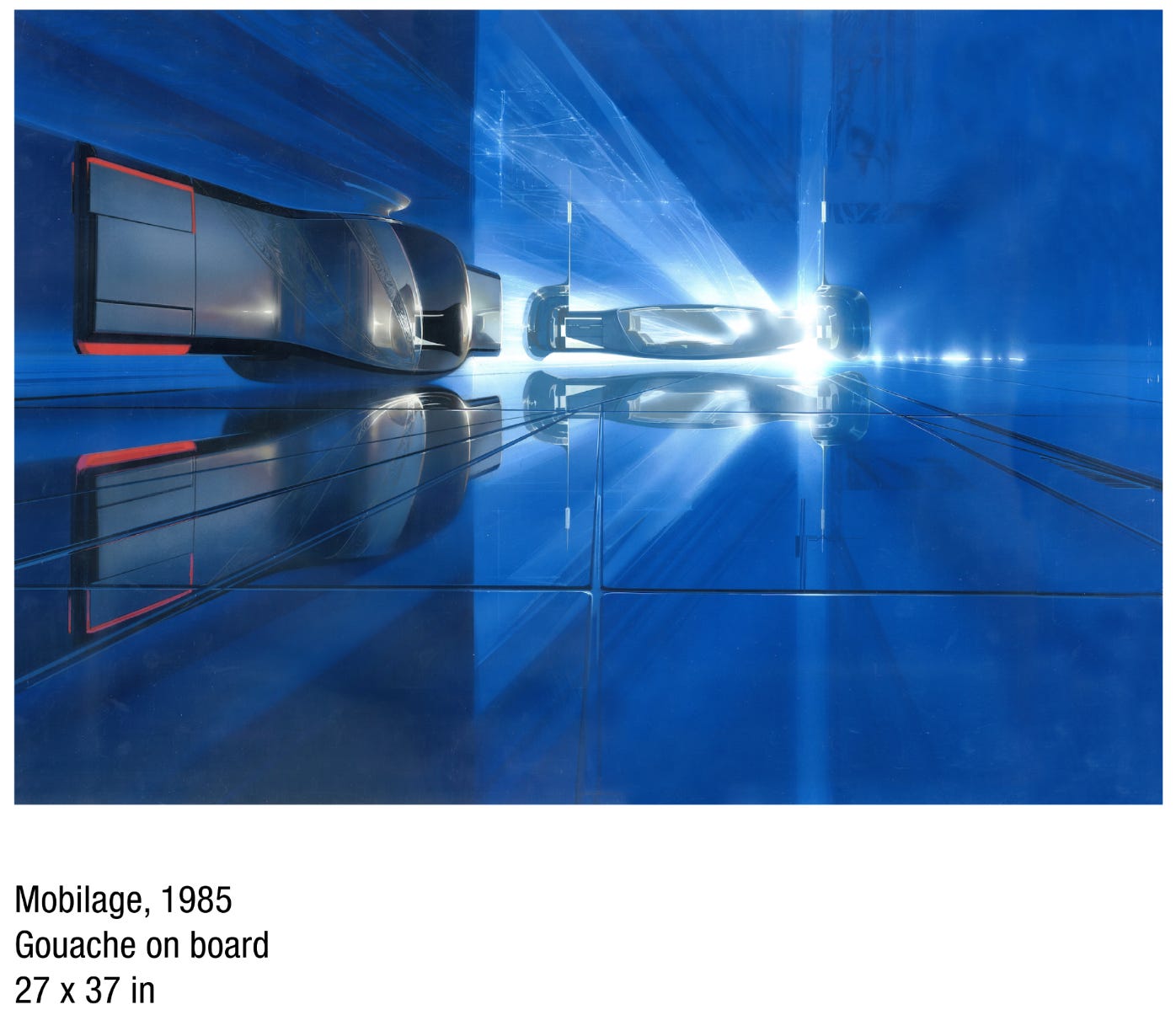
You have probably seen one of Syd Mead’s works whether you knew it or not, he’s one of the most iconic artists and industrial designers of the 20th century, and his art came to define what the future looks like in so many imaginations. Mead (1933–2019) was first known for works commissioned by large industrial and manufacturing concerns like Ford and U.S. Steel, and his commissioned work later appeared in magazines such as National Geographic. In his forties he worked on a number of film projects, and is also known for his contributions to films like Tron, Blade Runner and Aliens.
I caught this show when it was in New York and was lucky enough to see the SF exhibition when I was in town last week; I really find Syd to be a fascinating artist and man, and William is a font of information about Syd’s life, his visionary thinking, and his career.
Syd Mead: Future Pastime is open through December 17; if you’re in the Bay Area it is well worth a visit!
This interview has been condensed and edited. All images published with permission of Syd Mead: Future Pastime.
Can you tell me a little bit about Syd and where the idea for this exhibit came from?
Yes, so starting off with Syd. Syd is an industrial futurist, he is an optimistic futurist, he is a future forecaster, he is this visionary artist whose work was drawings and paintings, that’s how he communicated his visions with the world.
He started off in the world of automotive design at Ford, ended up getting pulled into a project with the United States Steel Corporation. I see it as like the birth of modern futurism as we know it, which really skyrocketed him into having a design practice and being pulled in by clients like Honda and NASA and Apple and Sony, the list just goes on and on and on.
Late career, what people most know him for is the world builder behind Blade Runner and Tron and many other films. I push people to look at that as a piece of who this man is and not him as a whole because, I think anyway, holistically, his practices are damn remarkable.
Yeah, I want to talk a little bit about that because I’ve got into Syd, and I saw your show in New York and we’re now at the one in San Francisco. His fingerprints are just everywhere; he’s, in many ways, the oxygen of any future-driven industrial design that you see. Do you want to speak to how he holistically designed these worlds and where we see his fingerprints?
Yeah, let’s go to an example. Let’s do Rays. So a little background on the work, Rays Wheels is a Japanese automotive wheel company.
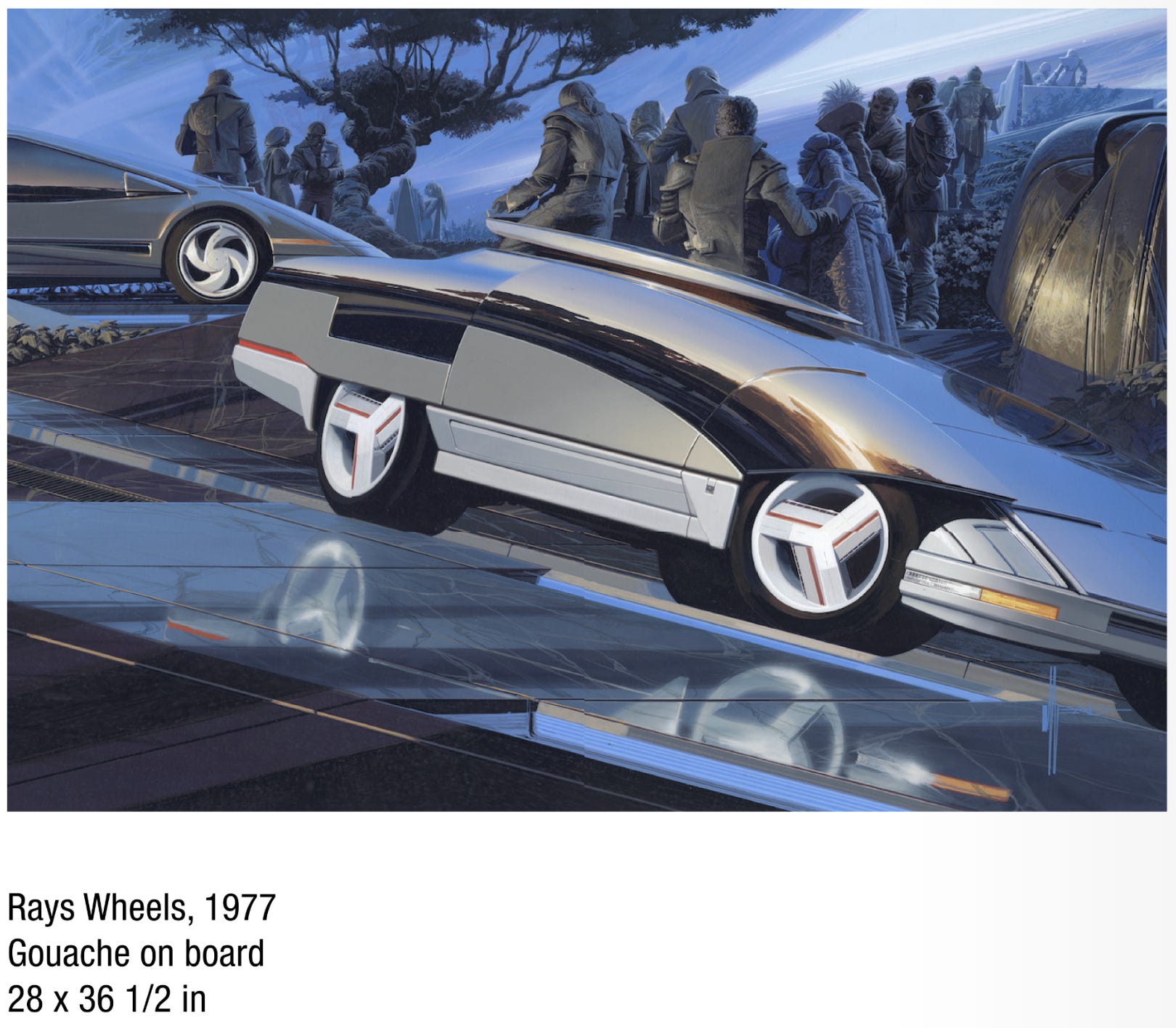
Syd was tasked with designing a new wheel. Syd is someone who can’t think of objects in isolation, he needs to think of them and how they live and breathe in the world around them. He has this formative background as this industrial designer and world building has always been very central to his thesis. So, with these wheels, you see him design a whole new car for it. The car behind said car holds the old wheels and Syd has placed it into this world, into this after party.
I take it as like the Hollywood Hills, there’s this goth punky scene. He has defined a fashion language for this moment and that is really how I see Syd thinking through his works. Whether commissions or personal, he is deciding to show you this crop, this picture, but he’s very much thinking about what happens behind it and beyond it.
Yeah, hearing you just describe that it reminds me of people holding J.R.R. Tolkien up as a really good example of a world builder and famously, he did the language first and then the world that stemmed from it. It seems like Syd has a visual language for the world that it’s in. It’s only part of the world, like the wheels that you’re highlighting in this one, and some of the other ones, this is the chance to get a glimpse of a very entirely thought out ecosystem.
Totally. I think that’s what drew me into Syd so much, what draws so many people in. It’s beautiful having a show of Syd’s and seeing the kinds of people that come through and resonate with it. It’s everyone from industrial design and architecture through automotive design. We’ve had people in humanoid robotics come in and make reference to Syd as a great book. He did work on Turn a Gundam and he has this remarkable, rarer book. It’s very small but it’s all the sketches and preliminaries behind his Gundam work. This company, they were saying that the armature, the joinery that Syd was working on is literally what we use today at — I won’t mention the company, but, at this major human robotics company.
It’s beautiful to have all these people come in and have this resonance with Syd and that goes to show his world building, his holistic sensibility of making a place for humans to want to live.
This is the ouroboros of technology and art, and they’re very much in conversation with Syd. It just feels fully in conversation with tech that came before, tech that came after, the art that came before, the art that came after. What are some ways that he is part of that cycle?
I’ll mention two works here just because we’re standing in front of this one, you can reverse the order if you want, but this is Party 2000. This is the year 1978. We are in this ripping, sexy, sensuous party scene. We are high up in a skyscraper overlooking a city that I’m sure there’s some familiarity with. It’s supposed to be this loose Brazilian coastal town or coastal city. But within this world, there’re two great moments of technology I love calling out.
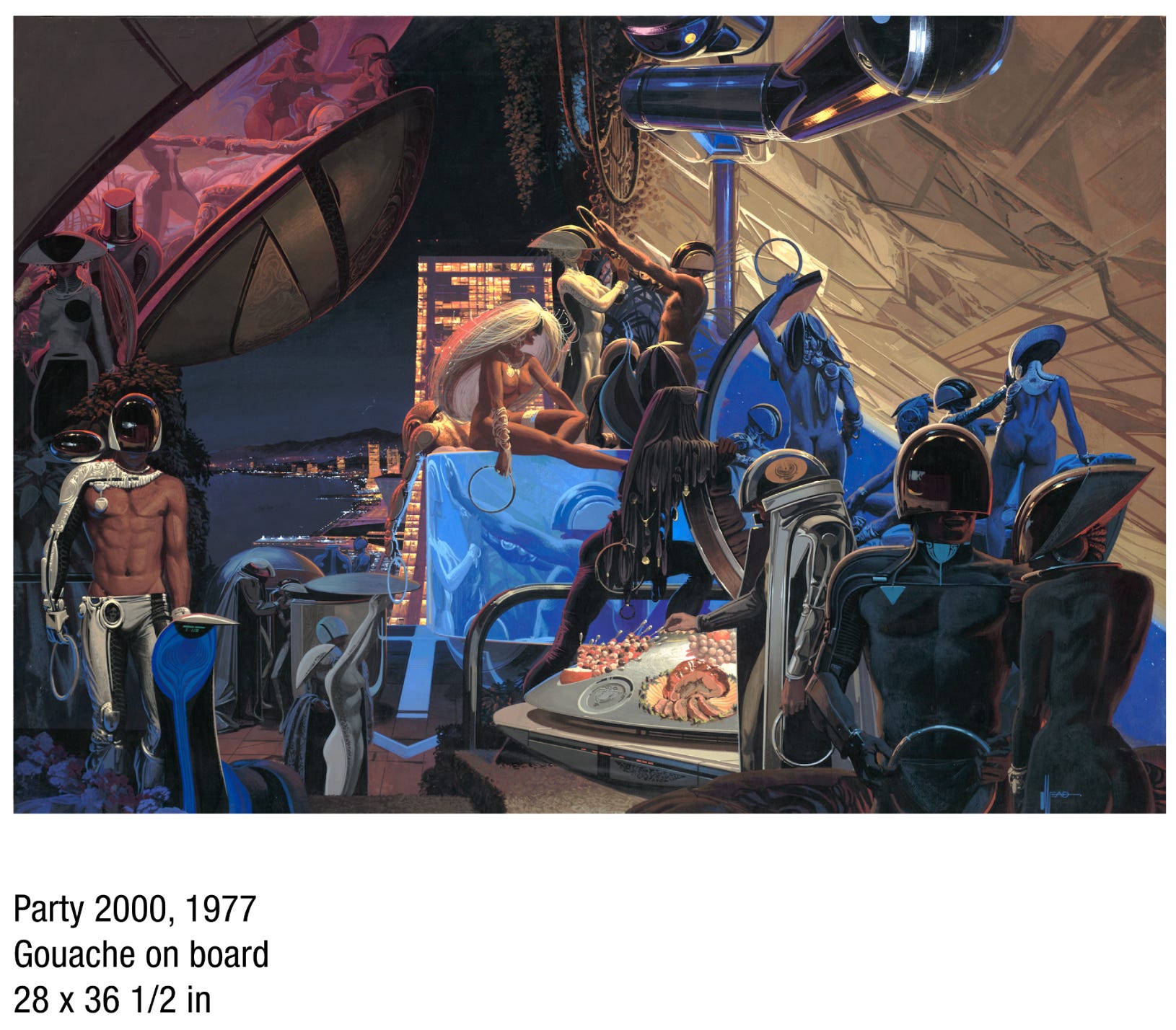
One is the “high-low rings.” Syd had defined this technology as sensory enhancers for parties. It was something that you can get higher or lower to, to get into this higher emotional state or lower one. And one beauty of Syd’s technology is it’s not this thing that you perform on yourself. It needs another. And you catch this moment of man bestowing this high low ring upon a woman to get her into a higher state of being.
And then there’s another moment that Syd writes about AI throughout his work. He’s been designing autonomous cars for the longest time. Syd was never someone who feared the rise of AI. He has this great quote, which I can find you and send over, but to boil it down, it was this idea of “AI should aid in us.” It should be helping us get to the place that we want to be versus having control over our destiny. You’ll catch throughout his works these floating spherical chromed out orbs. There were these autonomous agents, these companions, two people to ask questions to, to be there alongside them. You catch it above the gentleman with that bio-mechanical arm on the left side of the frame.
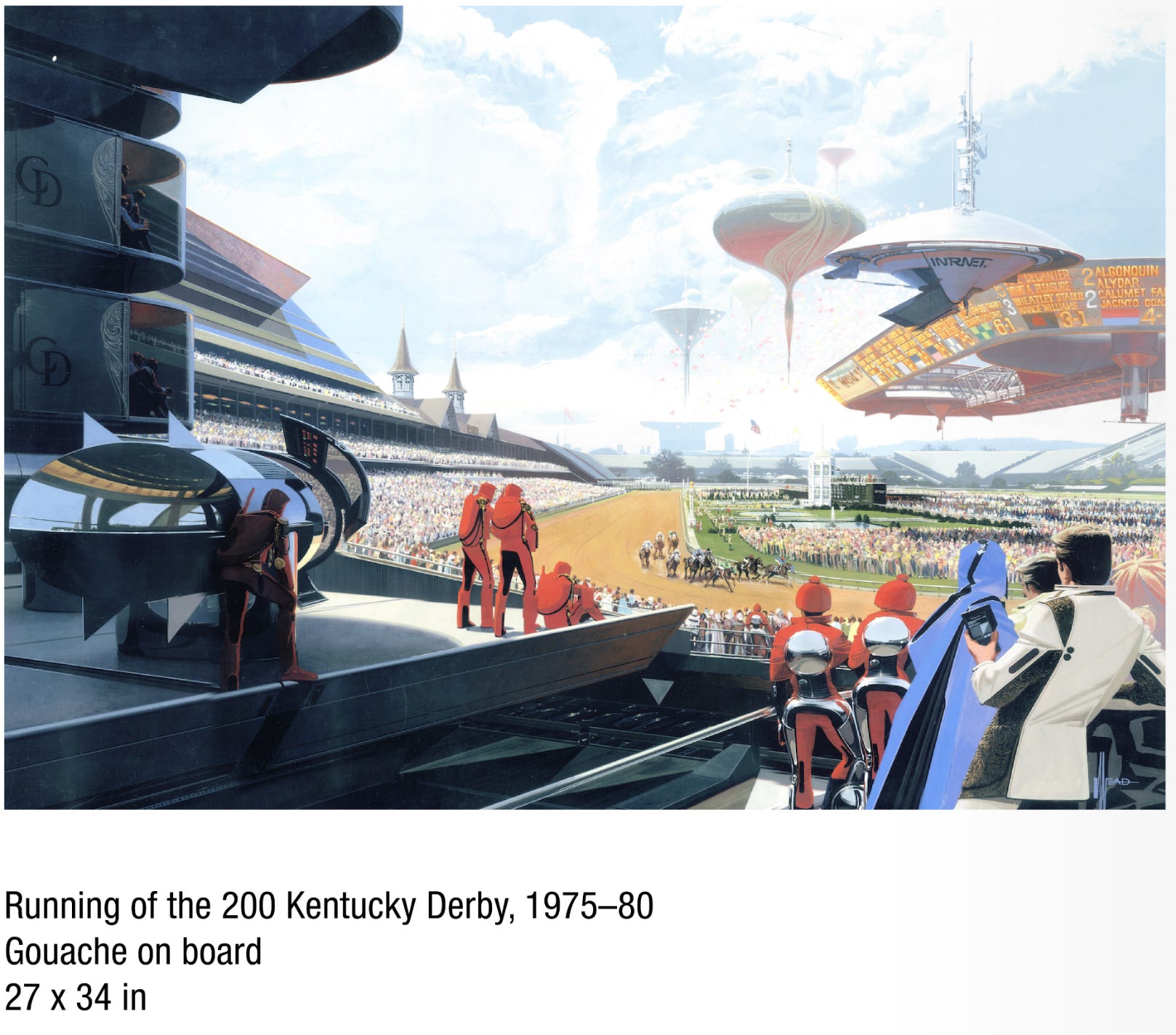
Some more tech to mention is the first work in the show, titled the 200th Running of the Kentucky Derby. And we catch a few really beautiful tech integrations. This is from ’75 to ’80. And there’s a gentleman on the bottom right corner holding a touchscreen phone. And it’s very casual. Syd wants you to see it. He’s not hiding this thing. Floating above him is this wireless communications hub with the word “internet” on it, which we know is the word coined by Stanford scientists in ’74.
Just putting forward this idea of wireless communication out into the world. You catch people with these wheeled shoes, these messengers dripped out in red with these spherical chrome backpacks on. They zip around the stadium and pass messages from one to the other. But again, it was this seamless, elegant integration of tech into his future. It was never this thing that was supposed to live so boldly and center stage. It was this thing that enabled humans to be humans and to connect with one another.
I’m so drawn to his work, I think, because again, he was a commercial artist. A lot of his work was on commission. A lot of the commissions that he worked on are on exhibition here. You mentioned something like half are companies or events or firms that brought him in to imagine what the future of our business and world could be like. It just feels like there’s an aspirational sense to so much of this.
Totally. I think Syd has this beautiful quote that “We must rehearse for a bright future in order to get to this place.” I see that with Syd’s work, the idea of putting forward these optimistic futures sets forward this chain reaction or this self-fulfilling prophecy. You see this beautiful vision, you act towards it and it comes true. I think we need more positivity. It was very purposeful for us to bring this show to San Francisco, knowing that the people here are very much deciding upon our future and making our future in front of us. To have more of these optimistic voices leading the charge, I think, is incredibly important and ones who take humanity seriously.
I know people may know his work from contract work that he did in film, but a lot of those are dystopian. It’s just so refreshing to actually see his personal projects, the work that really motivated him, the decades of work. This is aspirational, incredible, exciting. It’s a really fun show. Do you want to talk a little bit about how it came together and how these works are sourced? The variety is really, really exciting.
Yeah. Future Pastime came about as we knew that we needed to put together an exhibition that felt like a very strong survey of Syd’s body of work. We were very adamant at the gate. We don’t want to include film work. We don’t want that to be central. I didn’t want it to have this Mona Lisa effect of people only looking at this when the artwork that surrounds it deserves just as much eyeball attention, eyeball time.
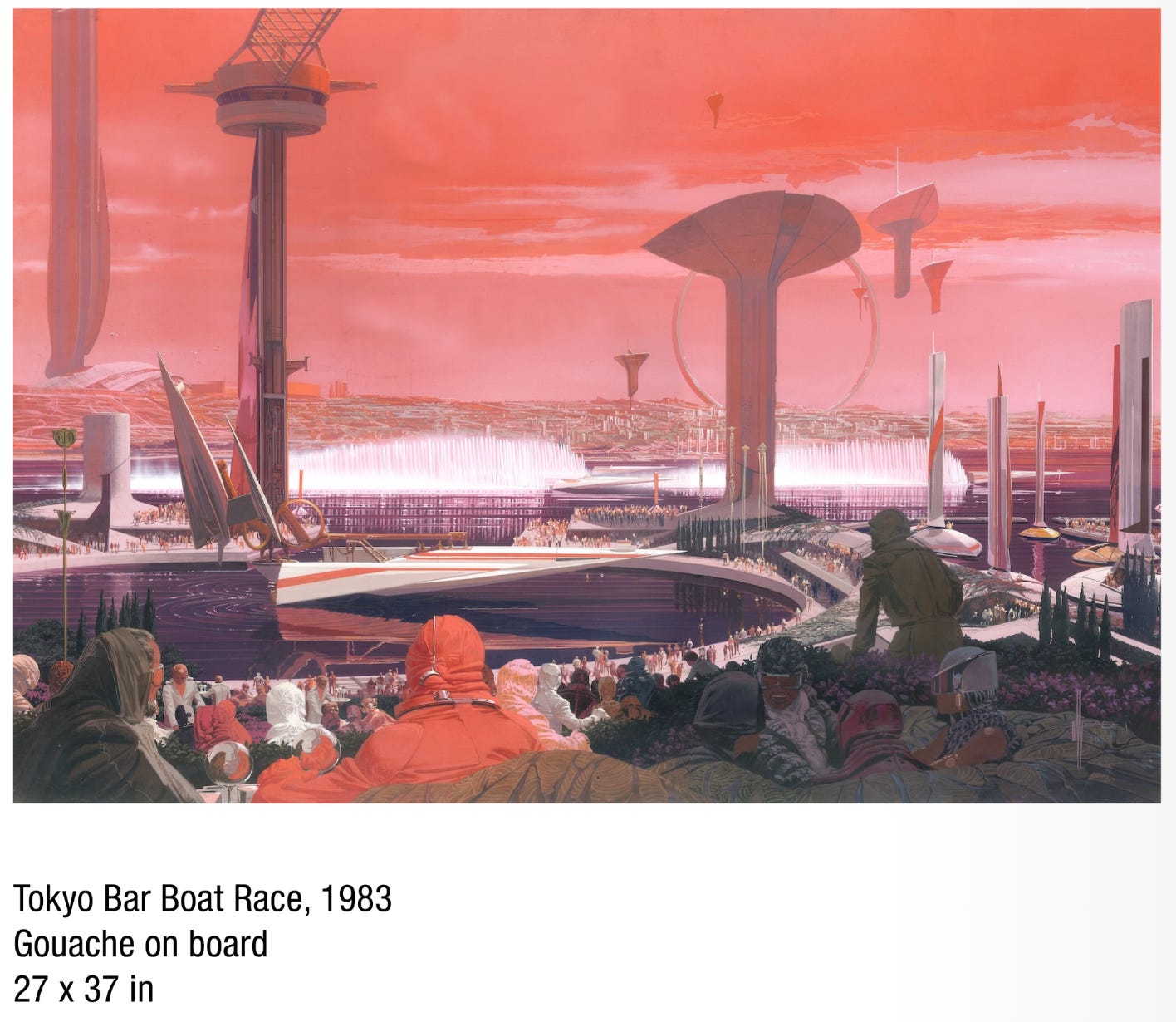
In terms of how this show came to be, we have been talking to the team of the Transamerica Pyramid for quite some time now. We were very eager to bring the show to San Francisco and to make this happen in the gallery annex of the Transamerica building was a dream. There’ve been some really remarkable shows here. The last show was Tara Donovan with ICA. Before that was Charles Rains and then it was Foster. There was this really great history of the space showing alternative discipline and architecture, design, furniture, sculpture. We knew we wanted it to happen here. It was also very important for us.
We really wanted to work with an architectural firm who understood Syd’s vision. There was alignment in practice and craft and we’ve been in touch with MAD architects for quite a long while now. We asked them to work with us in the exhibition design of the space, really keeping it raw to the pyramid. It’s just a remarkable space as is, but doing this very swift, gentle architectural intervention, they jumped on board. They were ecstatic.
There are these six plinths in the space when MAD and I and Elon were going through Syd’s work, there was a particular reference. It was actually another hypervan painting that he had done. You catch these triangular plinths chromed out in the work. We were having fun isolating objects within Syd’s work to just see how they feel. That one really resonated. That ended up being pulled out and brought into the space. It has this monolithic feeling like you’re walking up to this being, which I love.
Anyway, it came together with MAD. The Transamerica team has been amazing in helping this come to fruition.
That’s awesome. I remain astonished at the technical skill, what he’s able to do with gouache for chrome. The works are just inherently beautiful.
Yes. This is one of the many reasons I think one can be drawn to Syd is his masterful ability with gouache. It’s manipulation of gouache. It’s very classic. People come in and ask us if these are prints, if these are digital renderings. You just have to look closer and you will then maybe catch that brushstroke.
That’s amazing. How can people find the show and find you?
Please follow us at Syd_Mead. I think that’s been the big channel for all of our communication around this. The show Future Pastime is going to be at the Transamerica Pyramid Annex Gallery through December 17. There’s a chance that we ultimately extend the show to January.
Right now, it’s closing December 17th. We’re open Wednesday to Sunday, 11 to 6 p.m. Please come by! We love talking to people about Syd’s work and we see the show has transformed itself into a lightning rod for conversations about the future. Syd being the cornerstone of it.
Thank you!
Edited by Crystal Wang
If you have anything you’d like to see in this Sunday special, shoot me an email. Comment below! Thanks for reading, and thanks so much for supporting Numlock.